
A demat account is a paradox. It is the most important financial account most retail investors will ever open – the place where every share they buy actually lives – and it is also the account they research the least. Most investors choose a demat the way they choose a music streaming service: whichever app a friend recommended, or whichever ad they saw first. That casual decision quietly costs them money over decades.
This guide takes a different lens. Rather than ranking demat accounts on headline brokerage (which other articles do exhaustively), we focus on what actually matters once your shares are sitting in the account – the long-term cost of holding them, the friction of selling them, the cost of switching brokers if your needs change, and the safety of the institution. By the time you finish reading, you should know which of the top 10 demat accounts in India fits your situation, and equally important, which ones to avoid for your specific profile.
All 10 demat accounts here are SEBI-registered and operationally credible. Your shares will sit safely in CDSL or NSDL under your PAN regardless of which one you choose. The differentiation is above that baseline – in the recurring cost, the ancillary fees, the platform polish, and the ecosystem that comes with each account.
Brokerage is what you pay to transact. AMC is what you pay just to hold. Over 20 years of investing, the AMC math compounds to lakhs of rupees – which is why this guide ranks demat accounts on long-term cost, not headline brokerage.
What is a demat account and why your choice matters
A demat account is an electronic locker that holds your investments – stocks, bonds, mutual fund units, ETFs, government securities – in dematerialised form. Since the SEBI mandate in 2019, you cannot transfer physical share certificates anymore; everything must be in demat form. Your demat account is held at one of India’s two depositories – CDSL (Central Depository Services Limited) or NSDL (National Securities Depository Limited) – through a Depository Participant (DP), which is what every broker on this list operates as.
Why your choice of demat account matters more than most realise:
- AMC is the recurring cost of holding. Some demat accounts charge nothing per year. Others charge Rs. 700+. Over 20 years, that gap is Rs. 14,000 in pure carrying cost – before you even add a single transaction.
- DP charges scale with selling activity. Every time you sell from your demat, a DP charge applies – typically Rs. 12-25 + GST per scrip. If you make 50 partial sales a year (rebalancing, profit booking, tax harvesting), that is Rs. 1,000+ annually. Different brokers charge meaningfully different amounts.
- Transfer-out fees lock you in. If you decide to switch brokers later, you pay Rs. 20-100 per scrip to transfer your holdings. For a 30-scrip portfolio, that is Rs. 600-3,000 just to move – real friction that benefits the broker who already has your business.
Top 10 demat accounts in India 2026 – the ranked shortlist
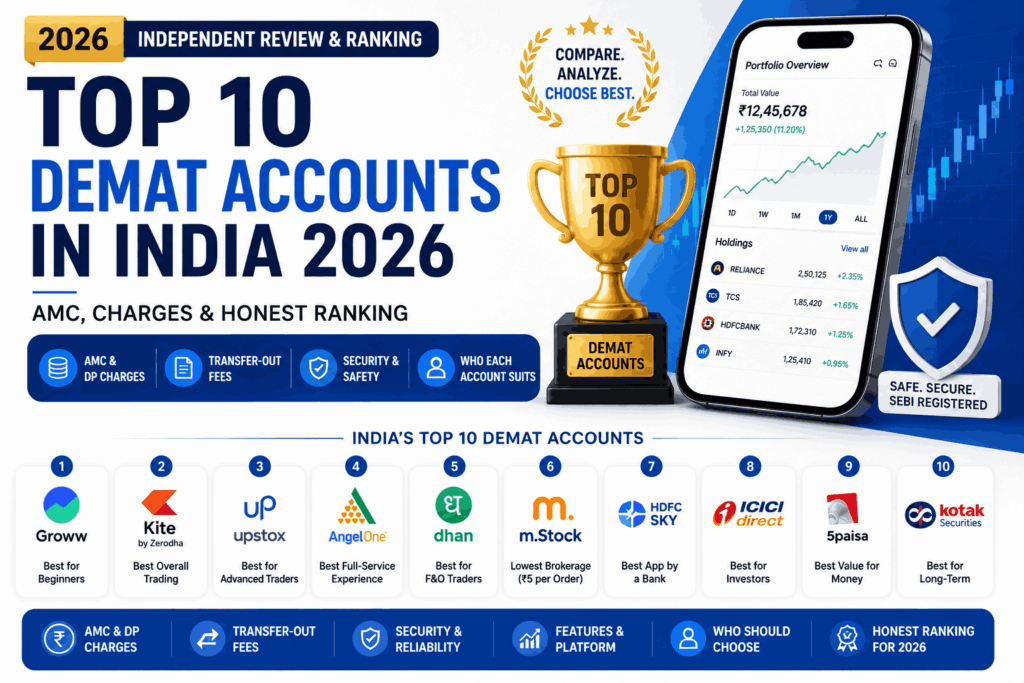
Here is our top 10, ordered with a bias toward long-term holding cost and accessibility for the average retail investor. All ten are SEBI-registered, all hold your shares in your name at CDSL or NSDL, and all support a complete range of products (stocks, mutual funds, IPOs, F&O):
| Rank | Demat Provider | Type | Demat AMC | Best For |
|---|---|---|---|---|
| 1 | Groww | Discount broker | Rs. 0 lifetime | First-time investors |
| 2 | Dhan | Discount broker | Rs. 0 lifetime | Cost-conscious investors |
| 3 | Zerodha | Discount broker | Rs. 300 / year | Active traders, DIY users |
| 4 | Angel One | Discount broker | Rs. 0 (Y1), Rs. 240 after | Research-led investors |
| 5 | m.Stock by Mirae | Discount broker | Rs. 0 (with Rs. 999 plan) | High-volume traders |
| 6 | Upstox | Discount broker | Rs. 150-300 / year | Mobile-first traders |
| 7 | Paytm Money | Discount broker | Rs. 0 | Paytm ecosystem users |
| 8 | ICICI Direct | Full-service / 3-in-1 | Rs. 700 / year | ICICI Bank customers |
| 9 | HDFC Securities (Sky) | Full-service / 3-in-1 | Rs. 0 basic plan | HDFC Bank customers |
| 10 | Kotak Securities | Full-service / 3-in-1 | Rs. 0 basic plan | Kotak Bank customers |
Detailed reviews of the top 10 demat accounts
1. Groww – the most accessible demat account in India
Groww overtook Zerodha as India’s largest broker by active NSE users in 2024-25, and its listed parent Billionbrains Garage Ventures went public in November 2025. The Groww demat account is held with CDSL, and the single biggest advantage is the lifetime zero AMC – you pay Rs. 0 per year just to hold securities, for as long as your account exists. That is genuinely unique among the top brokers.
Account opening: Free
Demat AMC: Rs. 0 lifetime
Best for: First-time investors, casual long-term holders
Pros
- Lifetime zero AMC – no recurring cost ever
- Fast Aadhaar-based account opening (under 5 minutes)
- Listed parent (post-November 2025) means strong public disclosure
- Mutual funds, stocks, IPOs, US stocks in one app
- Largest active user base in India
Cons
- Equity delivery brokerage no longer free (Rs. 20 or 0.1%)
- Charting tools basic vs TradingView-integrated platforms
- DP charges (Rs. 18.50 + GST) mid-pack
2. Dhan – zero AMC plus active trader tools
Dhan combines what investors usually have to pick between – a genuinely zero-AMC demat account with a serious active-trader platform on top. The demat is held at CDSL through Raise Securities Pvt. Ltd. (SEBI Registration INZ000006031). For investors who want to start as long-term holders but might eventually graduate to F&O or options trading, Dhan covers both spectrums without needing a second account.
Account opening: Free
Demat AMC: Rs. 0 lifetime
Best for: Investors who want low AMC + active trading tools
Pros
- Zero lifetime AMC
- Lowest DP charges among major brokers (Rs. 12.50 + GST)
- Best TradingView integration if you eventually trade actively
- Free equity delivery
- Strong API for algo developers (DhanHQ)
Cons
- Smaller customer base = thinner third-party tool ecosystem
- Customer support during major outages has been mixed historically
- No US stocks investing
- Learning curve steeper than Groww for beginners
3. Zerodha – the ecosystem winner with mid-tier AMC
Zerodha runs India’s most respected discount broker but charges Rs. 300 annually for demat AMC – notably higher than Groww, Dhan or HDFC Sky on this dimension. Over 10 years, that is Rs. 3,000 in pure carrying cost. The trade-off is access to the most mature ecosystem in Indian broking – Kite for execution, Coin for direct mutual funds, Console for reporting, Varsity for education, Kite Connect for algo trading, plus integrations with Sensibull, Streak, Smallcase and others. Whether the Rs. 300 AMC is worth it depends entirely on how much you use those tools.
Account opening: Rs. 200 (or free, depending on account type)
Demat AMC: Rs. 300 per year (billed quarterly)
Best for: Active traders, algo users, DIY investors
Pros
- Most reliable platform during volatile sessions
- Best third-party ecosystem (Sensibull, Streak, Smallcase, Varsity)
- Free equity delivery
- Debt-free, profitable, structurally stable company
- Kite Connect API is the most-used in India for algo trading
Cons
- Rs. 300/year AMC is higher than competitors
- Mutual funds in separate app (Coin)
- Kite Connect API now costs Rs. 2,000/month (since Feb 2025)
- Customer support response can be slow during peak hours
4. Angel One – tiered AMC with bundled research
Angel One offers a unique pricing structure – free demat AMC for the first year, then Rs. 240/year + GST thereafter. This makes Angel One an attractive demat for the first 12 months while you decide whether to commit, with the option to switch before the AMC kicks in if needed. Beyond pricing, Angel One bundles in-house research reports and ARQ Prime AI recommendations – useful for investors who want guidance alongside their demat.
Account opening: Free
Demat AMC: Free first year, Rs. 240/year afterward
Best for: Investors who want research bundled with their demat
Pros
- Free demat AMC for the first year
- In-house research and ARQ Prime AI recommendations included
- Free equity delivery
- Listed company (NSE/BSE) – public disclosures
- Wide product mix including commodities
Cons
- AMC kicks in from year 2 (Rs. 240/year)
- App can feel busy with research prompts
- Cross-sell prompts into adjacent products
- Pledge fees marginally higher than competitors
5. m.Stock – lifetime zero AMC via the Rs. 999 plan
m.Stock by Mirae Asset offers a unique pricing model – pay Rs. 999 once for lifetime zero AMC and another Rs. 999 once for lifetime zero brokerage. For an investor who plans to hold their demat for 5+ years, the math works decisively in m.Stock’s favour – Rs. 999 versus paying Rs. 500-700 annually elsewhere. The trade-off is the upfront commitment plus a platform that trails Zerodha and Dhan on UX polish.
Account opening: Free
Demat AMC: Rs. 999 one-time (lifetime zero)
Best for: Long-term holders, MTF and F&O users
Pros
- Lifetime zero AMC via Rs. 999 one-time payment
- Industry-leading MTF rates (6.99-14.99%)
- Mirae Asset institutional backing ($600B+ global AUM)
- Lower DP charges than most competitors
Cons
- Upfront Rs. 999 commitment can deter casual users
- Platform polish trails Kite and Dhan
- App reliability issues during volatile sessions
- No NRI account support
6. Upstox – polished mobile demat with moderate AMC
Upstox is backed by Ratan Tata and Tiger Global, and runs one of the most polished mobile-first demat experiences in Indian broking. The AMC at Rs. 150-300 per year (depending on plan) is between Groww’s free and Zerodha’s Rs. 300, with a clean mobile app that consistently rates among the best in India. For investors who want a balance between cost and modern UX, Upstox is a reasonable middle-ground choice.
Account opening: Free
Demat AMC: Rs. 150-300 per year
Best for: Mobile-first investors, young traders
Pros
- Polished mobile app experience
- Free equity delivery, Rs. 20 F&O
- TradingView charts integrated
- Tata and Tiger Global backing
Cons
- Demat AMC of Rs. 150-300/year still adds up over decades
- Customer support response times can be slow
- Smaller third-party ecosystem than Zerodha
- Education content thinner than Varsity
7. Paytm Money – friction-free demat for Paytm users
Paytm Money offers a zero-AMC demat account with tight integration into the broader Paytm ecosystem – particularly for users who already use Paytm for UPI and bill payments. The platform’s regulatory journey through 2024-2025 introduced some operational uncertainty, but for pure demat use – holding shares, mutual funds and bonds – it remains a functional zero-cost option.
Account opening: Free
Demat AMC: Rs. 0
Best for: Paytm ecosystem users
Pros
- Zero AMC
- Tight Paytm integration – one-tap fund transfer via UPI
- Free account opening
- Clean mobile UX for mutual funds and stocks
Cons
- Regulatory uncertainty around the parent in 2024-2025
- Smaller active client base reduces network effects
- Charting tools basic
- Transfer-out fee at Rs. 100 per scrip is high
8. ICICI Direct – the trusted full-service 3-in-1 demat
ICICI Direct is the largest full-service broker in India by client count, with a demat account tightly integrated into ICICI Bank’s 3-in-1 structure (savings + trading + demat). The annual AMC of Rs. 700 is meaningfully higher than discount brokers – but for ICICI Bank customers, the seamless fund movement, strong research and trusted brand backing of one of India’s largest private banks can justify the cost. As a demat-only choice for non-ICICI customers, the AMC is hard to defend.
Account opening: Free with bank account
Demat AMC: Rs. 700 per year
Best for: ICICI Bank customers, research-led investors
Pros
- Seamless 3-in-1 integration with ICICI Bank
- Strongest research reports in the broker landscape
- Access to US stocks via Global Investing module
- ICICI Securities institutional backing
Cons
- Highest AMC on this list (Rs. 700/year)
- Mobile app polish trails newer competitors
- Brokerage on certain plans is slab-based and complex
- Transfer-out fees high
9. HDFC Sky – the modern bank demat
HDFC Sky is HDFC Securities’ modernised retail offering, launched as a response to discount-broker disruption. The basic plan now offers zero demat AMC, free equity delivery is no longer charged, and the 3-in-1 integration with HDFC Bank is seamless. For HDFC Bank customers, this is the most genuinely competitive bank-based demat account in 2026. Platform polish has improved markedly but still trails pure discount brokers like Kite or Dhan.
Account opening: Free
Demat AMC: Rs. 0 (basic plan)
Best for: HDFC Bank customers wanting bank integration
Pros
- Zero AMC on basic plan – rare for a bank broker
- 3-in-1 integration with HDFC Bank
- Bundled research and recommendations
- Access to US stocks via Global Investing
Cons
- Higher DP charges than competitors (Rs. 25 + GST)
- Platform polish trails pure discount brokers
- No public algo trading API
- Plan structure switching can be manual
10. Kotak Securities – the under-30 advantage and Kotak banking integration
Kotak Securities took an unconventional pricing route in 2024 – free intraday and futures brokerage for traders under 30 years old, plus a zero-AMC demat on the basic plan. For Kotak Mahindra Bank customers, this is one of the strongest demat offerings in 2026. The 3-in-1 integration handles fund movement smoothly, and Kotak’s research depth is solid for an investor who values bundled insights.
Account opening: Free
Demat AMC: Rs. 0 (basic plan)
Best for: Kotak Bank customers, traders under 30
Pros
- Zero AMC on basic plan
- Free intraday and futures brokerage for under-30 users
- Kotak Mahindra Bank backing
- Strong banking integration for existing Kotak customers
Cons
- Benefits weaker if you do not bank with Kotak
- Brokerage on options not free even for under-30 users
- Mobile app polish trails Groww, Zerodha and Dhan
- Smaller third-party integration ecosystem
Long-term holding cost – what AMC actually adds up to
The headline AMC numbers do not feel meaningful in any one year. They become genuinely meaningful when you look at what they compound to over a long-term holding horizon. Here is the pure AMC cost over 5, 10 and 20 years for all 10 demat accounts:
| Provider | 5-yr Holding Cost | 10-yr Holding Cost | 20-yr Holding Cost |
|---|---|---|---|
| Groww | Rs. 0 | Rs. 0 | Rs. 0 |
| Dhan | Rs. 0 | Rs. 0 | Rs. 0 |
| Paytm Money | Rs. 0 | Rs. 0 | Rs. 0 |
| HDFC Sky (basic) | Rs. 0 | Rs. 0 | Rs. 0 |
| Kotak Sec. (basic) | Rs. 0 | Rs. 0 | Rs. 0 |
| m.Stock (with Rs. 999 AMC plan) | Rs. 999 one-time | Rs. 999 one-time | Rs. 999 one-time |
| Angel One (after Y1) | Rs. 960 | Rs. 2,160 | Rs. 4,560 |
| Upstox | Rs. 1,200 | Rs. 2,400 | Rs. 4,800 |
| Zerodha | Rs. 1,500 | Rs. 3,000 | Rs. 6,000 |
| ICICI Direct | Rs. 3,500 | Rs. 7,000 | Rs. 14,000 |
| Sharekhan | Rs. 2,000-3,500 | Rs. 4,000-7,000 | Rs. 8,000-14,000 |
Over a 20-year demat journey, the AMC gap between Groww/Dhan (Rs. 0) and ICICI Direct (Rs. 14,000) is real money. For a long-term equity investor who wants to hold and forget, choosing a zero-AMC broker is one of the highest-leverage cost decisions you can make.
DP charges, pledge fees and transfer-out costs compared
Beyond AMC, three other recurring charges meaningfully affect what you pay on your demat over time:
| Provider | Opening | DP per sell | Pledge/scrip | Transfer out |
|---|---|---|---|---|
| Groww | Free | Rs. 18.50 + GST | Rs. 20 + GST | Rs. 20 or 0.05% |
| Dhan | Free | Rs. 12.50 + GST | Rs. 15 + GST | Rs. 25 + GST per scrip |
| Zerodha | Free | Rs. 13.50 + GST | Rs. 30 + GST | Rs. 30 + GST per scrip |
| Angel One | Free | Rs. 15-20 + GST | Rs. 20 + GST | Rs. 50 per scrip |
| m.Stock | Free / Rs. 999 | Rs. 12.50 + GST | Rs. 30 + GST | Rs. 30 per scrip |
| Upstox | Free | Rs. 13.50 + GST | Rs. 25 + GST | Rs. 25 per scrip |
| Paytm Money | Free | Rs. 18.50 + GST | Rs. 30 + GST | Rs. 100 per scrip |
| ICICI Direct | Free | Rs. 20-30 + GST | Rs. 40 + GST | Rs. 50-100 per scrip |
| HDFC Sky | Free | Rs. 25 + GST | Rs. 35 + GST | Rs. 50 per scrip |
| Kotak Securities | Free | Rs. 20 + GST | Rs. 30 + GST | Rs. 50 per scrip |
Three observations:
- Dhan and m.Stock have the lowest DP charges. At Rs. 12.50 + GST per scrip on delivery sells, both are noticeably cheaper than Groww (Rs. 18.50) or full-service brokers (Rs. 20-30).
- Transfer-out fees vary by 5x. Groww at Rs. 20 per scrip is the cheapest; Paytm Money and ICICI Direct can charge Rs. 100 per scrip. If you have a 30-stock portfolio, that is the difference between Rs. 600 and Rs. 3,000 just to switch brokers.
- Pledge fees matter for MTF and collateral. If you plan to use Margin Trading Facility (borrow against your shares), pledge fees apply. The range is Rs. 15-40 per scrip. Dhan and m.Stock are among the lowest.
The BSDA exemption – free demat for small portfolios
SEBI’s Basic Services Demat Account (BSDA) regulation lets you maintain a demat account with significantly lower or zero AMC if your portfolio value stays below specified thresholds. Most retail investors with portfolios under Rs. 4 lakh are eligible, but few brokers actively advertise this. Here are the current BSDA tiers:
| Holdings Value | BSDA Maintenance Charge |
|---|---|
| Up to Rs. 50,000 | Rs. 0 (completely free) |
| Rs. 50,001 to Rs. 2,00,000 | Rs. 100 per year + GST |
| Rs. 2,00,001 to Rs. 4,00,000 | Rs. 100 per year + GST |
| Above Rs. 4,00,000 | Standard AMC of the broker applies |
How to claim BSDA benefits: you can only have one BSDA account at a time. The broker must apply BSDA pricing automatically if you qualify, but it is worth checking your billing to confirm. The threshold is monitored at the end of each billing cycle – if your portfolio crosses Rs. 4 lakh, BSDA stops applying for that cycle.
If you are a first-time investor building a portfolio under Rs. 50,000, you can hold a BSDA demat at any of the 10 brokers in this list for genuinely zero cost. As your portfolio grows past Rs. 4 lakh, standard AMC kicks in – which is exactly when choosing a zero-AMC broker like Groww or Dhan starts paying off.
How to choose the right demat account for you
Run these checks in order before opening a demat account. Doing this 30-minute exercise upfront saves you years of switching costs later:
| What to check | Why it matters |
|---|---|
| SEBI registration & DP membership | Confirms the broker can legally hold securities. Verify on the SEBI intermediary portal. |
| Annual AMC over 10 years | A Rs. 700/year AMC is Rs. 7,000+ over 10 years. Lifetime zero AMC saves real money. |
| DP charges per scrip on delivery sell | Apply every time you sell. Add up fast if you make many small sales. |
| Pledge / unpledge fees | Matter if you use Margin Trading Facility or pledge for collateral. |
| Transfer-out fee per scrip | Determines the cost of switching brokers later. Range: Rs. 20-100 per scrip. |
| NRI account support | Critical if you might become an NRI. Not all brokers offer NRE/NRO demat accounts. |
| Direct mutual fund access | Direct plans save 1%+ per year over regular plans. Some brokers only sell regular plans. |
| Customer support channels | Phone, chat, in-app ticketing – test response times before you actually need them. |
| Mobile app + web platform polish | You’ll spend hours in the interface. App ratings under 4.0 are warning signs. |
| BSDA eligibility | Free demat AMC for holdings under Rs. 50,000 – useful for new investors. |
Profile-based recommendations
- First-time investor (under Rs. 1 lakh portfolio): Groww or Dhan. Both have lifetime zero AMC. If you qualify for BSDA, you genuinely pay zero. Groww is friendlier; Dhan has better long-term active-trader optionality.
- Long-term passive investor (Rs. 5-50 lakh portfolio): Groww, Dhan or m.Stock (with Rs. 999 lifetime AMC plan). All three save you meaningful AMC over 10-20 years.
- Active trader (intraday or F&O): Zerodha for ecosystem + reliability; Dhan for options-focused trading. Both are zero or low recurring cost relative to what you save in execution quality.
- Bank customer wanting integration: HDFC Sky (zero AMC basic), Kotak Securities (zero AMC basic), or ICICI Direct (Rs. 700 AMC but strongest research). Match to your existing bank.
- NRI investor: ICICI Direct, HDFC Securities, Zerodha. Most discount brokers do not offer NRI accounts; m.Stock specifically does not. Check NRI account availability before opening.
Security, regulation and trust signals
All 10 demat accounts in this guide are SEBI-regulated. The structural protections are identical across all of them:
- Securities held in your name at CDSL or NSDL. Your shares are not held by the broker. Even in a worst-case broker insolvency, your shares stay in your demat account under your PAN and can be transferred to another broker.
- Client funds segregation. SEBI mandates separate bank accounts for client funds with daily settlement true-ups.
- Investor Protection Fund. Both NSE and BSE maintain IPFs covering eligible claims up to prescribed limits in case of broker default.
Where trust signals differ
- Publicly listed parents: Groww (Billionbrains Garage Ventures, listed Nov 2025), Angel One (listed since 2020) and ICICI Direct (subsidiary of ICICI Securities, listed) all face quarterly disclosure requirements. This is the strongest transparency framework among Indian brokers.
- Institutional bank backing: HDFC Sky (HDFC Bank), Kotak Securities (Kotak Bank), ICICI Direct (ICICI Bank), m.Stock (Mirae Asset) – all benefit from large institutional parents.
- Zerodha’s structural choice: Zerodha is debt-free, profitable, and has explicitly committed to staying private and never raising VC money. This is unusual and worth knowing if you weigh business-continuity risk.
2026 updates affecting demat account holders
- Groww IPO (November 2025): Largest fintech IPO in India in 2025. Strong transparency upgrade for Groww demat holders.
- Higher F&O STT (April 2026): Futures STT raised to 0.05% on sell side; options STT to 0.15% on sell premium. Identical at every broker.
- Updated capital gains tax: LTCG 12.5% above Rs. 1.25 lakh, STCG 20% on equity. Same across all demats.
- Continued BSDA promotion: SEBI has continued to push brokers to apply BSDA pricing automatically for eligible accounts. Some brokers still miss this – check your billing.
- Easier broker switching: CDSL’s Easiest portal now supports inter-broker transfers without physical DIS forms. The friction of switching has dropped meaningfully.
Frequently Asked Questions
Q1. Which is the best of the top 10 demat accounts in India in 2026?
There is no single best demat account – the right choice depends on your trading frequency and portfolio size. For first-time investors, Groww and Dhan are unbeatable on zero lifetime AMC. For active traders, Zerodha leads on ecosystem and reliability. For bank-account holders, HDFC Sky and Kotak Securities offer competitive zero-AMC plans with banking integration. All 10 are SEBI-registered and safe.
Q2. Which demat account has the lowest AMC?
Groww, Dhan, Paytm Money, HDFC Sky (basic plan) and Kotak Securities (basic plan) all charge zero AMC. m.Stock offers lifetime zero AMC for a Rs. 999 one-time payment. Zerodha charges Rs. 300/year, Angel One Rs. 240/year after the first year, and ICICI Direct Rs. 700/year. For long-term portfolios, zero AMC saves real money.
Q3. Can I open a demat account online in 2026?
Yes, all 10 demat accounts in this guide can be opened entirely online through Aadhaar-based e-KYC. The process typically takes 10-15 minutes of active effort, with account activation in 24-48 hours after SEBI and exchange verification. You will need PAN, an Aadhaar-linked mobile number, a bank account, and (for F&O activation) income proof.
Q4. What is the BSDA demat account and am I eligible?
BSDA (Basic Services Demat Account) is a SEBI-regulated demat tier with significantly lower or zero AMC for portfolio values up to Rs. 4 lakh. Holdings under Rs. 50,000 pay zero AMC; Rs. 50,001-Rs. 4 lakh pay Rs. 100/year. Most retail investors with small portfolios are eligible, but you can only hold one BSDA account at a time. The broker should apply BSDA pricing automatically if you qualify.
Q5. Are top 10 demat accounts in India safe?
Yes. All 10 demat accounts in this guide are operated by SEBI-registered stockbrokers and SEBI-registered Depository Participants at CDSL or NSDL. Your shares are held in your name (not by the broker), client funds are segregated per SEBI rules, and Investor Protection Fund coverage applies. The safety baseline is identical across all 10.
Q6. Can I have multiple demat accounts?
Yes. There is no SEBI limit on the number of demat accounts you can hold, as long as each is under your unique PAN. Many active traders maintain 2-3 demat accounts – typically a primary for active trading and a secondary for long-term holdings or backup. The CDSL Consolidated Account Statement aggregates holdings across all your demat accounts every six months for tax reporting.
Q7. What are DP charges and how much do they matter?
DP (Depository Participant) charges apply every time you sell shares from your demat account. Typically Rs. 12.50-25 + 18% GST per scrip. If you make 50 partial sales a year, DP charges can add up to Rs. 1,500-2,000 annually. Dhan and m.Stock have the lowest DP charges among the top 10 (Rs. 12.50); ICICI Direct and HDFC Sky charge the most (Rs. 20-30).
Q8. Can I transfer my demat account from one broker to another?
Yes. You can transfer all or part of your holdings from one broker’s demat account to another using a Delivery Instruction Slip (DIS) or, more conveniently, the CDSL Easiest portal. The transfer-out fee is typically Rs. 20-100 per scrip + GST, charged by the broker you are leaving. For a 30-stock portfolio, switching can cost Rs. 600-3,000. Groww and Dhan have the lowest transfer-out fees.
Q9. Do I need both CDSL and NSDL demat accounts?
No. Each demat account is held with either CDSL or NSDL through your broker. Most discount brokers in India use CDSL (Zerodha, Groww, Dhan, Upstox, Angel One, m.Stock). Some banks use NSDL (parts of HDFC Securities, ICICI Direct historically). The depository does not affect what stocks you can hold or buy – shares can move freely between CDSL and NSDL custody. You only need one demat account at one depository.
Q10. Which demat account should an absolute beginner pick?
Groww. The onboarding takes under five minutes via Aadhaar e-KYC, the interface is genuinely jargon-free, lifetime zero AMC means no recurring cost, and the platform is the largest in India by active user count – so you’ll have abundant community knowledge to draw on. As your needs evolve, you can graduate to Zerodha, Dhan or other platforms. But Groww is the right starting point for most new investors in 2026.
Final verdict on the top 10 demat accounts in India 2026
The Indian demat landscape in 2026 has converged on a few clear realities. Almost every major broker now offers free account opening. Five of the top 10 offer genuinely zero lifetime AMC. The friction of switching brokers has dropped because of the CDSL Easiest portal. Statutory charges (STT, GST, exchange transaction, stamp duty) apply uniformly across all brokers – you cannot save money there.
What this means: choosing the right demat account is less about cost (the cheapest brokers are similar) and more about fit. Three things to take away:
- Pick zero-AMC if you can. Over 20 years, the AMC compounds to Rs. 6,000-14,000 in pure carrying cost depending on which broker you choose. Groww, Dhan, HDFC Sky, Kotak Securities and Paytm Money all charge Rs. 0 – and m.Stock offers lifetime zero via a Rs. 999 one-time fee. There is rarely a good reason to pay Rs. 300-700 annually unless you genuinely need a specific feature only that broker offers.
- Match the demat to your trading frequency. If you trade actively, choose Zerodha or Dhan for execution depth. If you primarily hold long-term, choose Groww for simplicity. If you do MTF or options heavily, m.Stock saves real money. Optimising for the wrong dimension drains wealth over decades.
- Verify SEBI registration once, then commit. All 10 demat accounts in this guide are safe. Pick on capabilities, fit and ecosystem – and switch later if your needs change. The CDSL Easiest portal makes inter-broker transfers genuinely easy now.
Your demat account is the long-term home of your investments. Choose it with the same care you would choose a place to actually live – and revisit the choice every few years to make sure it still fits.
The best demat account is not the one with the cheapest brokerage on a single line – it is the one whose total cost, platform fit and ecosystem match how you actually invest over years.
