
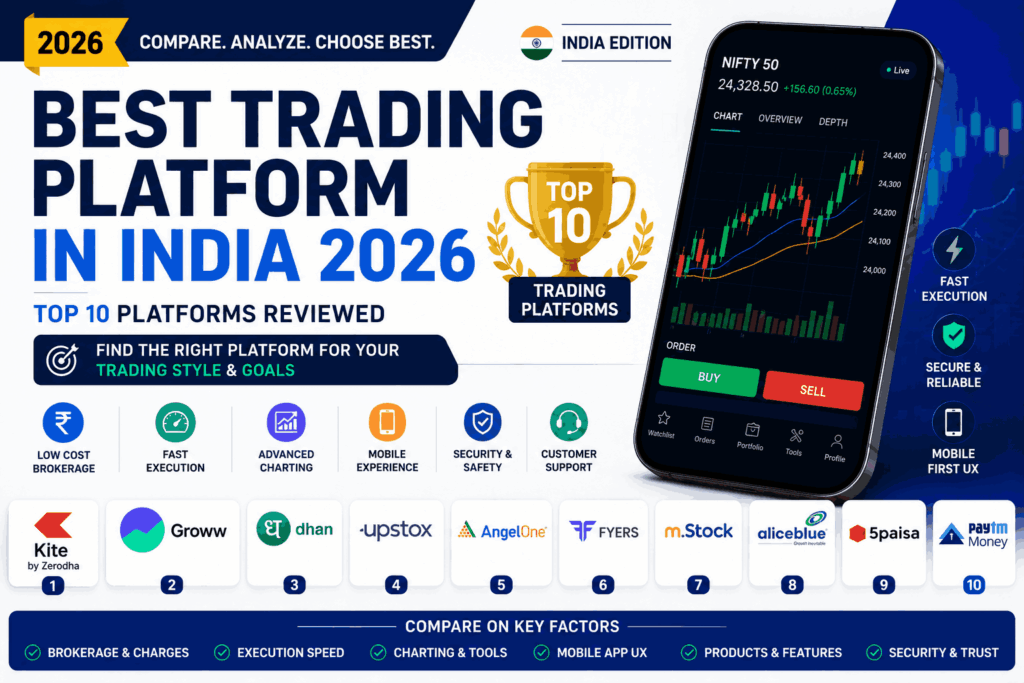
The Indian trading ecosystem in 2026 looks very different from what it was just a few years ago. Earlier, most retail investors ended up choosing between a handful of well-known brokers, but today the competition is far more specialized. Groww has emerged as the largest retail investing platform after its public listing, Dhan has built a strong reputation among active derivatives traders, and platforms like m.Stock are attracting users with ultra-low brokerage models. Even established financial brands such as HDFC Sky are aggressively upgrading their technology and mobile experience to stay relevant in the discount-broker era.
Because of this shift, there is no single platform that works best for everyone. A long-term investor looking for mutual funds and SIPs may value simplicity and a clean app interface, while a high-frequency trader may focus entirely on charting tools, execution speed, and platform stability during volatile market hours. Cost also plays a role, but lower brokerage does not always guarantee a better trading experience.
In this article, we move beyond generic broker comparisons and focus specifically on trading platforms. We compare the top platforms in India across important parameters such as brokerage charges, order execution, charting capabilities, mobile usability, ecosystem features, and security standards. Whether you are a beginner investor, an options trader, or an active intraday participant, this guide will help you identify the platform that best matches your trading needs and investing style.
There is no universally best trading platform in India. There is the platform whose strengths match how you actually invest – and the cost of choosing wrong is measured in lakhs of rupees over decades, not in headline brokerage rates.
How we evaluated the best trading platforms in India
Most “best of” lists rank platforms on a single dimension – usually headline brokerage. That misses the point. The real question is which platform delivers the most value across the full set of things that matter to traders and investors. We used six criteria:
| Criterion | Why It Matters in 2026 |
|---|---|
| Cost transparency | All-in cost (brokerage + AMC + DP) over a typical year, not the headline brokerage rate alone. |
| Execution speed | Sub-100ms order placement. Matters most on F&O and intraday during volatile sessions. |
| Charting depth | Native or TradingView-integrated charts with multi-timeframe analysis. Crucial for active traders. |
| Mobile UX | How quickly a new user can place a trade, set an alert, or run a SIP. Day-1 friction matters. |
| Ecosystem & APIs | Connected tools (Sensibull, Smallcase, Streak), algo trading APIs and educational content. |
| Security & uptime | SEBI registration baseline plus published uptime metrics, complaint ratios and structural safety. |
Two notes on the methodology before diving in. First, every platform on this list operates under SEBI regulation, holds shares in CDSL or NSDL under your PAN, and segregates client funds. The baseline safety story is identical. Differentiation happens above that baseline.
Second, this guide does not assume you are a beginner, an active trader, or an algo developer. Different platforms win for different profiles. Use the decision framework at the end to match a platform to your situation.
Best trading platforms in India 2026 – the shortlist
Here is our shortlist of the ten best trading platforms in India in 2026. The order is not a strict ranking – it broadly reflects market share and user volume, but the right platform for you is the one whose standout edge matches your needs. All ten are SEBI-registered and operationally credible.
| Rank | Platform | Built By | Best For | Standout Edge |
|---|---|---|---|---|
| 1 | Kite | Zerodha | Active traders & DIY investors | Reliability + ecosystem |
| 2 | Groww App | Groww (publicly listed) | First-time investors | UX + zero AMC + transparency |
| 3 | Dhan | Raise Securities | F&O / options traders | TradingView + options chain |
| 4 | Upstox Pro | Upstox (Tata-backed) | Mobile-first young traders | App polish + speed |
| 5 | Angel One | Angel Broking | Research-led investors | ARQ AI + bundled research |
| 6 | 915 by Groww | Groww (new 2025) | Active traders who want Groww | Pro terminal within Groww ecosystem |
| 7 | m.Stock | Mirae Asset | High-volume MTF + F&O | Rs. 999 lifetime brokerage plan |
| 8 | HDFC Sky | HDFC Securities | HDFC banking customers | 3-in-1 banking integration + research |
| 9 | ICICI Direct Neo | ICICI Direct | ICICI banking customers | Trusted PSU-grade backing |
| 10 | Sharekhan TradeTiger | Sharekhan by BNP Paribas | Desktop terminal traders | Pro-grade desktop platform |
Detailed reviews of the 10 best trading platforms
1. Kite by Zerodha – the benchmark for reliability
Kite remains the gold standard for active trading in India. Used by Zerodha’s ~78.9 lakh active clients (FY 2025-26), the platform is built around three principles – speed, reliability and simplicity. Charts have native TradingView integration. Order entry is keyboard-driven with hotkeys most active traders memorise within a week. Execution latency is consistently among the lowest in the industry.
What truly sets Kite apart is the ecosystem. Kite Connect API powers the largest algo trading community in India. Sensibull (options analysis), Streak (no-code algos), Smallcase (thematic investing) and Tijori (stock research) all integrate natively. Varsity is India’s best free trader-education library. For active traders, Kite is the platform around which others are measured.
Built by: Zerodha (founded 2010, Bengaluru)
Best for: Active traders, DIY investors, algo developers
Pricing edge: Free equity delivery, Rs. 20 F&O cap
Pros
- Best uptime and execution speed in the industry
- Kite Connect API is the gold standard for algo trading
- Varsity education library is unmatched
- Free equity delivery still
- Strong third-party tool ecosystem (Sensibull, Streak, Smallcase)
Cons
- Rs. 300/year demat AMC – higher than Groww, Dhan, m.Stock
- Mutual funds in a separate app (Coin)
- Kite Connect API now costs Rs. 2,000/month (since Feb 2025)
- Customer support response times can lag during peak hours
2. Groww App – the most accessible platform
Groww overtook Zerodha as India’s largest broker by active NSE users in 2024-25, and Billionbrains Garage Ventures (the listed parent) went public on November 12, 2025. As of April 2026, the share trades around Rs. 218 – more than 2x the IPO price. The platform now operates under the disclosure regime of a listed company, the only major discount broker with that level of transparency.
Operationally, Groww remains the most accessible platform in India. Onboarding via Aadhaar e-KYC takes under five minutes. The interface is genuinely jargon-free. Stocks, mutual funds, F&O, US stocks, IPOs, bonds, ETFs and digital gold sit in one app. For users who never plan to use advanced order types or algo trading, Groww gives you everything else with the least friction.
Built by: Groww Invest Tech Pvt. Ltd. (listed parent: Billionbrains Garage Ventures)
Best for: First-time investors, SIP-led users, mainstream traders
Pricing edge: Zero lifetime AMC; Rs. 20 / 0.1% on equity, flat Rs. 20 on F&O
Pros
- Cleanest beginner UX in Indian trading
- Zero lifetime AMC – genuinely unique advantage
- US stocks integrated natively
- Post-IPO disclosure transparency
- Largest active user base in India
Cons
- Equity delivery no longer free (Rs. 20 or 0.1% since mid-2024)
- Charting tools basic vs TradingView-integrated platforms
- Limited advanced order types
- MTF interest ~14% – higher than Zerodha and m.Stock
3. Dhan – the F&O specialist’s platform
Dhan is the most technically-impressive trading platform launched in India in the last five years. Built by Raise Securities (founded 2021 by Pravin Jadhav and team), Dhan focuses obsessively on active traders – especially in F&O and options. The platform integrates TradingView at a depth no other Indian broker matches and was awarded TradingView’s “Best Broker APAC” in both 2023 and 2024.
For options traders specifically, Dhan is unmatched. The options chain shows live Greeks and OI data with sub-second updates. Basket orders and Flash Trade let you execute multi-leg strategies in milliseconds. The platform supports advanced order types – bracket orders, cover orders, GTT, AMO – that some competitors still hide behind multiple menu layers. Dhan’s API (DhanHQ) is well-documented and increasingly adopted by independent algo traders.
Built by: Raise Securities Private Limited (Mumbai-based)
Best for: Active F&O traders, options strategists, scalpers
Pricing edge: Free delivery + zero AMC + Rs. 20 F&O
Pros
- Deepest TradingView integration in Indian broking
- Best-in-class options chain with live Greeks
- Zero AMC and free equity delivery
- Strong API (DhanHQ) for algo traders
- Advanced order types built in
Cons
- Steeper learning curve for beginners
- Smaller third-party tool ecosystem vs Kite
- Customer support during major outages has been mixed historically
- Smaller active client base than the top three
4. Upstox Pro – the polished mobile-first platform
Upstox is backed by Ratan Tata and Tiger Global, and the platform reflects that backing – polished, mobile-first, designed for the segment of traders who want a clean app but also want fast execution. The TradingView integration is solid. The mobile app is consistently among the best-rated Indian trading apps on app stores. Active client count sits around 27 lakh – smaller than Zerodha and Groww but in the same league.
Where Upstox Pro shines is the casual-to-active spectrum. Beginners can use the simplified mode; active traders can switch to Upstox Pro which exposes advanced charting and order types. Algo trading via the Upstox API is functional, though less mature than Kite Connect.
Built by: RKSV Securities (Tata-backed)
Best for: Mobile-first traders, young active users
Pricing edge: Free equity delivery, Rs. 20 F&O cap
Pros
- Polished mobile app, especially on Android
- TradingView charts built in
- Solid order execution speed
- Algo API for developers
Cons
- Customer support response time can be slow
- App has had occasional downtime during high-volatility sessions
- Call & Trade fees are higher than competitors
- Education content thinner than Zerodha’s Varsity
5. Angel One – the research-bundled discount broker
Angel One is a category of one in 2026 – it bridges the discount-broker and full-service-broker worlds better than anyone else. You get the Rs. 20-per-order pricing standard among discount brokers, but you also get in-house research reports, ARQ Prime AI recommendations, and an optional relationship-manager service for premium clients. Active client count crossed 75 lakh in early 2026.
For investors who want discount-broker pricing alongside guidance, Angel One is the most logical choice. The trade-off is that the app feels busier than purer discount platforms like Kite or Dhan – all the research insights, recommendations and AI prompts add UI density that some users find distracting.
Built by: Angel Broking (founded 1987, listed on NSE/BSE)
Best for: Investors who want research alongside execution
Pricing edge: Free delivery + Rs. 20 F&O + research bundled
Pros
- In-house research reports and ARQ AI recommendations
- Free equity delivery
- SmartAPI for algo trading
- Wide product mix including commodities and currencies
- Listed company – public disclosure requirements
Cons
- App feels busy compared with Kite or Groww
- Quality of AI recommendations varies
- Cross-sell prompts into adjacent products
- Charting trails Kite and Dhan on advanced features
6. 915 by Groww – the new entrant for active traders
Launched in 2025, 915 by Groww is the company’s response to losing active traders to Kite and Dhan. It is a web-based pro-trading terminal built specifically for high-frequency and active users, separate from the main Groww app. The product targets users who like the Groww ecosystem – mutual funds, US stocks, IPOs – but need professional-grade tools for active trading.
As of May 2026, 915 is still maturing. Charting depth, advanced order types and execution-speed parity with Kite are not fully there yet. But the product direction is right, and for existing Groww users who would otherwise have to maintain a second account at Zerodha or Dhan, 915 keeps them in the ecosystem. Worth watching as it evolves.
Built by: Groww (new product, 2025)
Best for: Groww users who want to upgrade to active trading
Pricing edge: Inherits Groww pricing, no separate plan fee
Pros
- Single ecosystem covers basic to active trading
- No separate account or upfront fee
- Web-based, accessible across desktops
- Backed by listed-parent transparency
Cons
- Still maturing – tooling depth lags Kite and Dhan
- Algo API ecosystem early stage
- Smaller user community for troubleshooting
- Limited education content for active trading
7. m.Stock – the lifetime brokerage platform
m.Stock by Mirae Asset is one of the few genuinely differentiated trading platforms in India in 2026. The pitch is simple – pay Rs. 999 once, and brokerage on most segments becomes either Rs. 5 or zero for life. Combined with industry-leading MTF rates (6.99-14.99%) and the institutional backing of Mirae Asset Group, it offers a structurally different value proposition from every other discount broker.
The platform itself is functional but not in the same league as Kite or Dhan on UX polish. The app has had reliability issues during volatile sessions that surface regularly in user reviews. Customer support response times are inconsistent. For high-volume F&O and MTF traders willing to trade UX polish for cost savings, m.Stock saves five-figure rupees annually. For others, the upfront commitment is hard to justify.
Built by: Mirae Asset Capital Markets (India), 2022
Best for: High-volume F&O and MTF traders
Pricing edge: Rs. 999 lifetime plan = Rs. 5/order F&O + Rs. 0 delivery
Pros
- Lowest F&O brokerage among major brokers (Rs. 5/order)
- Lowest MTF rates in India (6.99% at top tier)
- Institutional backing from Mirae Asset Group ($600B+ AUM)
- Lifetime zero AMC available (separate Rs. 999)
Cons
- Upfront Rs. 999 commitment may not pay back for casual users
- App reliability issues during volatile sessions
- No NRI account support
- Smaller third-party tool ecosystem
8. HDFC Sky – the modernised bank platform
HDFC Securities’ Sky platform is the bank’s response to the discount-broker disruption. Re-launched in 2023 with a flat Rs. 20 brokerage structure and zero AMC for basic plans, Sky has become the most genuinely competitive bank-based trading platform in 2026. It combines 3-in-1 integration with HDFC Bank (savings + trading + demat), in-house research reports, and discount-broker-style pricing.
Where Sky still trails the pure discount brokers is platform polish and feature depth. Charting is mid-tier – functional but not at Kite or Dhan level. Algo trading APIs are not publicly available. For HDFC Bank customers who value the seamless banking integration and the research bundled in, Sky is genuinely a credible alternative to opening a separate account at Zerodha or Groww.
Built by: HDFC Securities (re-launched 2023)
Best for: HDFC Bank customers wanting bank integration
Pricing edge: Rs. 20 flat brokerage + zero AMC on basic + research bundled
Pros
- Seamless 3-in-1 integration with HDFC Bank
- Bundled research reports and recommendations
- Strong infrastructure backing from HDFC Securities
- Access to US stocks via Global Investing
Cons
- Platform polish trails Kite, Dhan and Groww
- Charting tools mid-tier
- No public algo trading API
- Smaller user community – fewer YouTube tutorials and community guides
9. ICICI Direct Neo – the trusted full-service platform
ICICI Direct remains the largest full-service broker in India by client count, with the Neo platform offering a more competitive pricing tier alongside the traditional slab-based structure. The 3-in-1 integration with ICICI Bank, the research depth, and the brand trust of one of India’s largest private banks make this a credible choice – particularly for ICICI Bank customers who value seamless fund movement.
The trade-off is cost. Even on the Neo plan, ICICI Direct’s pricing structure is more complex than pure discount brokers, with higher AMC (Rs. 700+ annually) and slab-based brokerage on certain plans. For investors prioritising lowest cost, ICICI Direct is not the answer. For investors prioritising trusted institutional backing and a single integrated relationship with their bank, it is one of the best options available.
Built by: ICICI Direct (subsidiary of ICICI Securities)
Best for: ICICI Bank customers, investors valuing trust
Pricing edge: Multiple plans including Neo flat-fee tier
Pros
- Strongest research reports in Indian broking
- Seamless 3-in-1 integration with ICICI Bank
- Access to US stocks via Global Investing module
- Breeze API for algo traders
- Brand trust of ICICI Securities
Cons
- Higher AMC than discount brokers (Rs. 700+/year)
- Slab-based plans can confuse retail users
- Mobile app polish trails newer competitors
- Plan switching can be a manual process
10. Sharekhan TradeTiger – the pro desktop terminal
If you are looking for a genuinely professional desktop trading terminal in 2026, Sharekhan’s TradeTiger remains the standard. Owned by BNP Paribas, Sharekhan has positioned itself as a premium full-service broker – higher brokerage rates than discount platforms, but with desktop and web-based tools that match what institutional traders expect. TradeTiger supports multi-monitor setups, complex order types, real-time charting, and the keyboard-driven workflows that high-frequency retail traders prefer.
The trade-off is pricing. Sharekhan’s brokerage of 0.10-0.50% on delivery (depending on plan) is dramatically higher than the Rs. 0 most discount platforms offer. For ultra-active desktop traders who genuinely use the professional toolset, the cost may be justified. For everyone else, discount platforms with TradingView integration deliver 80% of the experience at 5% of the cost.
Built by: Sharekhan (owned by BNP Paribas)
Best for: Desktop-first active traders, advanced workflows
Pricing edge: Premium platform with pro-grade desktop terminal
Pros
- TradeTiger desktop terminal is genuinely pro-grade
- Multi-monitor and keyboard-driven workflows
- Strong research desk with frequent reports
- BNP Paribas institutional backing
Cons
- Brokerage of 0.10-0.50% on delivery is high
- Annual AMC of Rs. 400-700
- Mobile app polish trails pure-discount platforms
- Plan structures can be opaque without a relationship manager
Cost comparison – all 10 platforms in 2026
Here is how the 10 platforms stack up on the core cost drivers. Statutory charges (STT, GST, exchange transaction charges, stamp duty, DP charges) apply uniformly across all SEBI-registered brokers – only the brokerage and AMC lines vary.
| Platform | Account Opening | Delivery | F&O | Annual AMC |
|---|---|---|---|---|
| Kite (Zerodha) | Free | Free | Rs. 20/order | Rs. 300 |
| Groww App | Free | Rs. 20 or 0.1% | Rs. 20/order | Rs. 0 lifetime |
| Dhan | Free | Free | Rs. 20/order | Rs. 0 |
| Upstox Pro | Free | Free | Rs. 20/order | Rs. 150-300 |
| Angel One | Free | Free | Rs. 20/order | Rs. 0 (Y1) |
| m.Stock (Zero plan) | Free + Rs. 999 | Free | Rs. 5/order | Rs. 0 (extra Rs. 999) |
| HDFC Sky | Free | Rs. 20 | Rs. 20 | Rs. 0 (basic plan) |
| ICICI Direct Neo | Free | Rs. 20 | Rs. 20 | Rs. 700 |
| Sharekhan | Free | 0.10-0.50% | Rs. 100/lot or % | Rs. 400-700 |
Pricing has converged dramatically. Most discount platforms offer free delivery and Rs. 20-per-order F&O. The differentiation is no longer cost – it is platform experience, ecosystem depth, and reliability.
Feature comparison – charting, APIs and beyond
Feature parity has improved across the industry, but meaningful differences remain in algo trading, charting depth, MTF rates, and US stocks access:
| Platform | Charting | Algo API | MTF | US Stocks | Algo Tools |
|---|---|---|---|---|---|
| Kite (Zerodha) | Advanced + TradingView | Yes (Rs. 2,000/mo) | Yes | No (paused) | Sensibull, Streak |
| Groww App | Basic-Mid | Yes (newer) | Yes (~14%) | Yes | Limited |
| Dhan | TradingView native | Yes (DhanHQ) | Yes | No | Built-in options chain |
| Upstox Pro | TradingView | Yes | Yes | No | Some integrations |
| Angel One | Mid | Yes (SmartAPI) | Yes | No | ARQ AI |
| m.Stock | Mid | Limited | Yes (6.99-15%) | No | Limited |
| HDFC Sky | Mid | No public API | Yes | Yes (Global) | HDFC research |
| ICICI Direct Neo | Mid | Yes (Breeze API) | Yes | Yes (Global) | ICICI research |
| Sharekhan | Pro desktop | No public retail API | Yes | No | TradeTiger workflow |
How to choose the best trading platform for you in 2026
Use this profile-based decision framework to match a platform to your situation:
| Your Profile | Recommended Platform |
|---|---|
| First-time investor, mostly SIPs | Groww App – lowest friction onboarding, zero AMC, beginner-friendly UX |
| Active intraday trader | Kite (Zerodha) – most reliable execution, third-party tool depth |
| F&O / options specialist | Dhan – TradingView native, best options chain in Indian broking |
| Long-term equity investor | Kite or Dhan – both offer free delivery; pick based on tool preference |
| High-volume F&O (50+ orders/day) | m.Stock Zero plan – Rs. 5/order saves five-figure rupees annually |
| Beginner with HDFC banking | HDFC Sky – 3-in-1 integration, bundled research |
| Beginner with ICICI banking | ICICI Direct Neo – 3-in-1 integration, trusted PSU-grade backing |
| Algo / API trader | Kite Connect (Zerodha) – most-used API in India + best documentation |
| Trader wanting US stocks | Groww App or ICICI Direct – both offer LRS-based US investing |
| Desktop terminal user | Sharekhan TradeTiger – genuinely pro desktop experience |
Three principles worth applying
- Match the platform to your trading frequency. Active F&O traders should optimise for execution speed, charting and brokerage cost – Kite, Dhan or m.Stock. Long-term investors should optimise for AMC and direct mutual funds – Groww or Dhan. Mismatching profile to platform quietly drains wealth over years.
- Consider the ecosystem, not just the platform. Kite integrates with Sensibull, Streak, Smallcase and Varsity. Groww gives you stocks + MF + US stocks + IPOs in one app. Dhan gives you the best options chain in India. The platform you choose shapes which third-party tools you can use.
- Have a backup for high-stakes days. No Indian broker has zero downtime. Active traders should maintain a secondary account at a different broker – typically Zerodha as primary, Dhan as backup, or vice versa – so a platform outage on Budget day or RBI policy day does not block a critical trade.
Security, regulation and trust signals
All ten platforms on this list operate under SEBI’s regulatory framework. The baseline protections apply equally:
- Securities held in your name. Whether you trade through Kite, Groww, Dhan or HDFC Sky, your shares sit in your own demat account at CDSL or NSDL under your PAN.
- Client funds segregation. SEBI mandates that client funds be kept in separate bank accounts with daily settlement true-ups. None of these platforms can use your money for their own business.
- Investor Protection Fund coverage. NSE and BSE both run IPF schemes that cover eligible claims up to prescribed limits in case of broker default.
Where platforms differ on safety signals
- Publicly listed parents. Groww (Billionbrains Garage Ventures, listed Nov 2025), Angel One (listed since 2020) and ICICI Direct (subsidiary of ICICI Securities, listed) have quarterly disclosure obligations. This is the strongest transparency signal among Indian brokers.
- Institutional backing. m.Stock (Mirae Asset, $600B+ global AUM), HDFC Sky (HDFC Bank), Sharekhan (BNP Paribas) all benefit from large institutional parents. ICICI Direct is the largest private-bank broker.
- Zerodha’s debt-free structure. Zerodha is debt-free, profitable, and has explicitly stated it will not raise VC money or go public. This is structurally different from VC-funded competitors – whether you find it more or less reassuring depends on your view of public-market accountability.
Safety baseline is consistent across all SEBI-registered platforms. Choose a platform for its capabilities, not for fear that another platform might be unsafe – that fear is mostly unfounded under India’s current regulatory framework.
What changed in Indian trading platforms in 2026
- Groww IPO (November 2025): Largest fintech IPO in India in 2025. Listed at Rs. 100, trading around Rs. 218 in April 2026.
- 915 by Groww launched: New pro-trading web terminal for active traders.
- Kite MCP integration: Zerodha became the first Indian broker to integrate with Model Context Protocol, allowing AI assistants like Claude, ChatGPT and Gemini to interact with the trading account.
- Higher F&O STT (April 2026): Government raised STT on futures (0.02% to 0.05% on sell) and options (0.10% to 0.15% on sell premium). Identical at every broker.
- Updated capital gains tax: LTCG at 12.5% above Rs. 1.25 lakh, STCG at 20% across equity. Same across all platforms.
- Kite Connect API pricing: Now Rs. 2,000/month since February 2025.
- MTF expansion: Zerodha expanded eligible stocks to 1,300+ with up to 5x leverage. Other brokers have similar offerings now.
Frequently Asked Questions
Q1. Which is the best trading platform in India in 2026?
There is no single best platform – the right choice depends on your trading style. For active intraday traders and DIY investors, Kite by Zerodha is the most reliable platform with the deepest ecosystem. For first-time investors, Groww is the easiest entry point. For F&O specialists, Dhan offers the best options interface. For high-volume traders, m.Stock’s Rs. 999 lifetime plan saves the most money. All ten platforms in this guide are SEBI-registered and operationally safe.
Q2. Which is the cheapest trading platform in India?
For casual use, Dhan and m.Stock (Basic plan) are effectively the cheapest – free delivery, zero AMC, Rs. 20 F&O. For high-volume traders, m.Stock’s Rs. 999 lifetime plan brings F&O brokerage down to Rs. 5 per order. For absolute zero-cost long-term investors, Groww still wins on lifetime zero AMC. The cheapest platform depends on your trading volume.
Q3. Is Kite by Zerodha better than Groww for active trading?
Yes, for most active traders. Kite has more reliable execution under stress, deeper third-party ecosystem (Sensibull, Streak, Smallcase), the most-used algo trading API in India (Kite Connect), and the best free education library (Varsity). Groww is genuinely better for beginners and first-time investors, but Kite is the more complete active-trading platform.
Q4. Which trading platform is best for F&O and options in India?
Dhan. The TradingView integration is the deepest among Indian brokers, the options chain shows live Greeks and OI data with sub-second updates, multi-leg basket orders are built in, and Flash Trade lets you execute complex strategies in milliseconds. Dhan won TradingView’s “Best Broker APAC” in both 2023 and 2024. Kite is a strong second through Sensibull integration.
Q5. Is the Groww trading platform safe after its IPO?
Yes. Groww Invest Tech Pvt. Ltd. is SEBI-registered (INZ000301838), and its listed parent Billionbrains Garage Ventures Limited has been publicly traded on NSE/BSE since November 12, 2025. The IPO triggered quarterly financial disclosures and the corporate-governance standards of a listed company. Securities are held in CDSL under your PAN, client funds are segregated, and Investor Protection Fund coverage applies. The post-IPO transparency is the strongest among Indian discount brokers.
Q6. Can I have accounts on multiple trading platforms in India?
Yes. Many active traders maintain accounts on two or three platforms – typically a primary platform for daily trading and a backup for high-stakes sessions. Common combinations include Zerodha + Dhan (active trading) and Groww + Zerodha (basic + advanced). The CDSL Consolidated Account Statement aggregates holdings across all your demat accounts every six months for tax reporting.
Q7. What is the best trading platform for beginners in India?
Groww. The onboarding takes under five minutes via Aadhaar e-KYC, the interface is genuinely jargon-free, the minimum SIP is Rs. 100, and lifetime zero AMC means there is no recurring cost. As your needs evolve toward active trading, you can graduate to Zerodha or Dhan, or use 915 by Groww as an in-ecosystem upgrade path.
Q8. Which trading platform offers US stocks investing in India?
Groww, ICICI Direct (Global Investing), Angel One, HDFC Sky and 5paisa (via Vested partnership) all offer US stock investing under the RBI’s Liberalised Remittance Scheme (LRS), with the $250,000 annual limit per person. Groww’s interface is among the simplest; ICICI Direct’s Global Investing module is the most established with deeper research.
Q9. Are all Indian trading platforms regulated by SEBI?
Yes. Every platform in this guide is regulated by SEBI (Securities and Exchange Board of India). Each has a SEBI stockbroker registration number, depository participant membership at CDSL or NSDL, and operates under SEBI’s client-funds segregation, settlement and grievance redressal rules. Always verify a broker’s SEBI registration on the official SEBI intermediary portal before opening an account.
Q10. Should I use a desktop platform or mobile app for trading?
It depends on your trading style. Casual or long-term investors are perfectly served by mobile apps – the Groww app, Kite mobile and Dhan all work well on phones. Active intraday or F&O traders, especially those running multiple watchlists or basket orders, benefit from desktop terminals – Kite Web, 915 by Groww or Sharekhan TradeTiger. Most active traders use desktop during market hours and mobile after-hours.
Final verdict on the best trading platform in India 2026
The Indian trading platform landscape in 2026 is genuinely competitive in a way it has never been before. Discount platforms have raised their game on UX (Groww, Dhan), traditional players have caught up on pricing (HDFC Sky, Angel One), and newer entrants are challenging on cost (m.Stock) and AI integration (Kite MCP). The result: investors have more credible choices than ever, but the difference between choices is more nuanced than a single “best” pick can capture.
Three things to take away from this best trading platform in India guide:
- Cost has converged – experience differentiates. Most discount platforms charge Rs. 20 or 0.1% F&O and free or near-free delivery. Choosing the right platform now depends on execution speed, charting depth, ecosystem and your trading style – not headline brokerage.
- Match the platform to your dominant use case. Active F&O trader = Kite or Dhan. First-time investor = Groww. Bank customer wanting integration = HDFC Sky or ICICI Direct. High-volume MTF trader = m.Stock. Optimising for the wrong dimension wastes thousands of rupees and hours of UI friction.
- Verify SEBI registration once, then commit. All ten platforms in this guide are regulated. Safety is not the right axis for choosing among them. Pick on capabilities, fit and ecosystem – and switch later if your needs change.
The best trading platform in India in 2026 is the one whose strengths match how you actually trade. For the active trader who values reliability, Kite remains the gold standard. For the first-time investor who values simplicity, Groww is unrivalled. For the F&O specialist, Dhan leads. Beyond these three, the right choice depends on the use case you actually have – and the easiest way to know is to try a platform for a few weeks before deciding. The first month of actual use will tell you more than any review article.
The best trading platform is not the one with the loudest marketing or the lowest headline brokerage. It is the one you will still be using comfortably in three years – through bull markets, corrections, and the slow process of learning what kind of investor you actually are. Optimise for that.
