
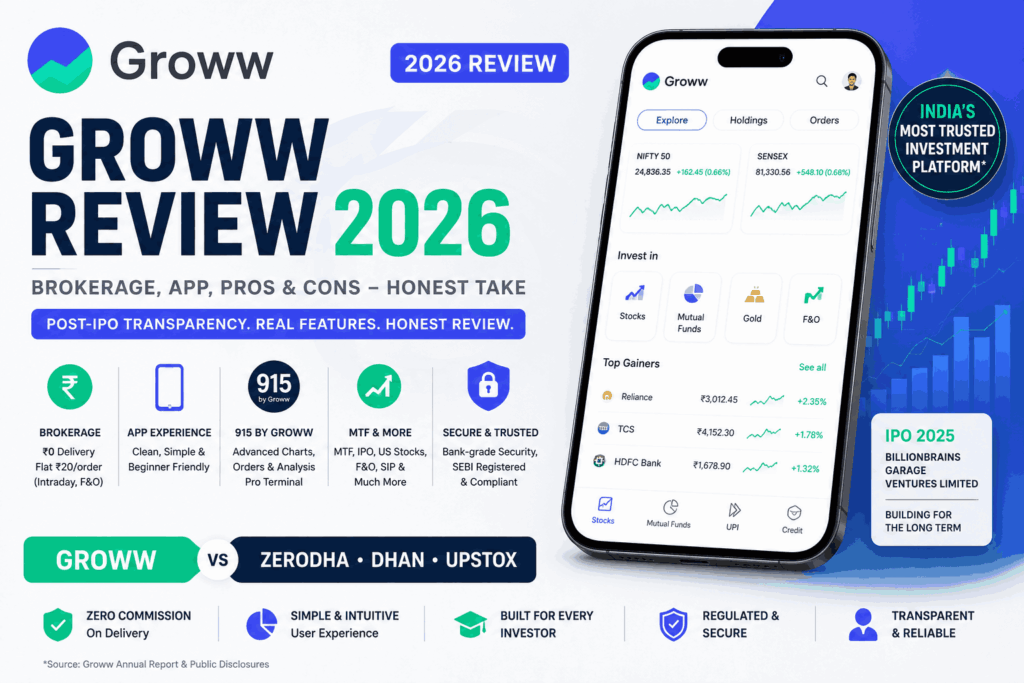
Five years ago, asking which broker had the cleanest first-time-investor experience in India had a single answer – Zerodha. That answer has changed. As of mid-2025, Groww overtook Zerodha to become India’s largest stockbroker by active NSE users, and it has held that lead through 2026. In November 2025, Groww’s listed parent (Billionbrains Garage Ventures Limited) went public at Rs. 100 per share and trades around Rs. 218 today – which means the company now operates under the disclosure regime of a publicly-traded entity. That changes how this review is written.
When a broker is public, the financial data is verifiable. Groww’s FY 2025 revenue of Rs. 3,901 crore and profit before tax of Rs. 2,463 crore are not industry rumour – they are SEBI-filed numbers. Its 1.5 crore+ user base across 900+ Indian cities is no longer marketing copy; it is documented in the RHP. This level of transparency separates Groww from most of its competitors, including some that have been around for longer.
This Groww review covers what matters for the investor deciding whether to open an account in 2026 – the brokerage structure (which changed in the last 18 months), the platforms (including the new 915 by Groww pro terminal), MTF, US stocks, security and trust signals, and where Groww genuinely fits versus Zerodha, Dhan, Upstox and Angel One. By the end, you should know whether Groww is the right broker for the way you actually invest.
Groww is no longer just “the beginner’s app.” Post-IPO, with 1.5 crore users and a pro trading terminal launched, the platform now spans the full spectrum from first-time SIP investor to advanced active trader. The question is whether it serves any one segment best – or whether it spreads itself thin.
The Groww story: from mutual fund distributor to listed broker
Groww was founded in 2016 by four ex-Flipkart colleagues – Lalit Keshre, Harsh Jain, Ishan Bansal, and Neeraj Singh – with an unusual starting point. Rather than launching as a full brokerage, the team focused obsessively on one product first: direct mutual fund distribution. By 2018, Groww had become one of India’s most-downloaded mutual fund apps. The decision to lead with mutual funds, not stocks, turned out to be strategically smart – the user base built then carried over when stock trading launched in early 2020.
The product expansion since has been steady but never reckless. Stocks in 2020. ETFs and IPOs the same year. Digital gold soon after. F&O, US stocks, bonds, sovereign gold bonds, MTF, algo trading APIs – each added when the user base was ready, not before. The acquisition of Indiabulls AMC (now Groww Mutual Fund) in 2023 brought asset-management capability in-house. And the November 2025 IPO marked the formal transition from venture-backed startup to publicly-traded financial services company.
| Attribute | Groww (May 2026) |
|---|---|
| Founded | 2016 (mutual funds since 2017; stocks since 2020) |
| Founders | Lalit Keshre, Harsh Jain, Ishan Bansal, Neeraj Singh |
| Broking entity | Groww Invest Tech Pvt. Ltd. (formerly Nextbillion Technology) |
| Listed parent | Billionbrains Garage Ventures Limited (NSE/BSE since Nov 12, 2025) |
| Headquarters | Vaishnavi Tech Park, Bellandur, Bengaluru |
| SEBI Registration | INZ000301838 |
| Depository | CDSL (DP ID: IN-DP-417-2019) |
| Active clients (NSE) | Largest in India by active users (as of June 30, 2025) |
| Total users | 1.5+ crore across 900+ cities |
| Revenue FY 2025 | Rs. 3,901 crore (up from Rs. 2,609 crore FY24) |
| Profit before tax FY 2025 | Rs. 2,463 crore |
| IPO listing | 12 November 2025 at Rs. 100 price band |
| Account opening fee | Free |
| Demat AMC | Rs. 0 lifetime |
| Brokerage model | Rs. 20 or 0.1% (lower) on equity; flat Rs. 20 on F&O |
Why the IPO matters for users
Going public has implications beyond the founders cashing out. Three things change materially when a broker becomes a listed company:
- Quarterly disclosures. Groww now files quarterly financial statements with SEBI and stock exchanges. Revenue, profitability, user growth, segment-wise numbers – all public. This level of transparency is unmatched among Indian discount brokers (most of which are private). Users can now genuinely audit the business health of the platform holding their money.
- Stronger governance. Listed companies face stricter corporate-governance requirements – independent directors, audit committees, related-party transaction disclosures. The day-to-day operational impact is small, but the institutional discipline matters over a long-term investing horizon.
- Public-market pressure. This cuts both ways. On one hand, Groww now has incentive to keep its users engaged and revenue-generating (which can mean more cross-sell prompts). On the other hand, public-market scrutiny tends to discourage aggressive behaviour like hidden fees or quiet UI degradations.
Groww brokerage charges in 2026
Groww’s brokerage structure has gone through one important change in the last 18 months – and it caught a lot of users off-guard. Earlier, Groww offered free equity delivery. That changed in mid-2024. Today, equity delivery is no longer free at Groww – you pay Rs. 20 or 0.1% (whichever is lower, with a Rs. 5 minimum) on both delivery and intraday.
| Segment | Groww Brokerage (2026) |
|---|---|
| Equity Delivery | Lower of Rs. 20 or 0.1% per executed order (minimum Rs. 5) |
| Equity Intraday | Lower of Rs. 20 or 0.1% per executed order (minimum Rs. 5) |
| Equity Futures | Flat Rs. 20 per executed order |
| Equity Options | Flat Rs. 20 per executed order |
| Currency Futures | Flat Rs. 20 per executed order |
| Currency Options | Flat Rs. 20 per executed order |
| Commodity (MCX) | Flat Rs. 20 per executed order |
| Direct Mutual Funds | Rs. 0 commission |
| IPO Applications | Rs. 0 (free) |
| Bonds & SGBs | Rs. 0 brokerage |
| US Stocks (Groww US Stocks) | Free; FX conversion fee applies |
| MTF (Pay Later) | Lower of Rs. 20 or 0.1% per order plus interest |
The break-points to keep in mind:
- Trade value below Rs. 5,000: you pay the Rs. 5 minimum brokerage
- Trade value Rs. 5,000 to Rs. 20,000: you pay 0.1% of trade value
- Trade value above Rs. 20,000: you pay the Rs. 20 flat cap
The shift from ‘free delivery’ to ‘Rs. 20 or 0.1%’ was the single most material pricing change at Groww in recent years. For long-term equity investors making large infrequent buys, Groww is no longer cheaper than Zerodha or Dhan (both of which still offer free delivery). For most other use cases, the impact is minimal.
Account opening, AMC and other charges
Beyond brokerage, here is the full charge structure for the Groww demat account in 2026:
| Charge | Amount (May 2026) |
|---|---|
| Account opening (online) | Free |
| Demat AMC | Rs. 0 lifetime – no quarterly or annual fee |
| Trading AMC | Rs. 0 |
| DP charges (per scrip sold) | Rs. 18.50 + 18% GST per debit transaction |
| Call & Trade | Rs. 50 per executed order |
| Auto square-off (intraday) | Rs. 50 per order |
| Pledge / Unpledge | Rs. 20 per scrip + GST |
| MTF interest rate | ~14% per annum on outstanding |
| Securities transfer out | Rs. 20 per ISIN or 0.05% (whichever higher) |
| Account closure | Free |
| Physical CMR / contract note | Rs. 50 + courier; electronic notes free |
| FX conversion (US Stocks) | 0.99% on USD/INR conversion |
Three charges worth flagging specifically:
- Lifetime zero AMC. This is Groww’s single biggest cost advantage. Over 10 years, that is Rs. 3,000 saved versus Zerodha’s Rs. 300/year, and Rs. 7,000+ saved versus full-service banks like ICICI Direct. Genuinely meaningful for long-term portfolios.
- DP charges of Rs. 18.50 + GST per scrip on delivery sells. Mid-pack rate – higher than Zerodha’s Rs. 13.50, lower than Angel One. Applies regardless of trade value, so small frequent sells become disproportionately expensive.
- MTF interest at 14% per annum. Higher than Zerodha (~10.5%) and dramatically higher than m.Stock (6.99% at top tier). If you use MTF meaningfully, Groww is not the cheapest place to do it.
The Groww platforms: mobile, web and the new 915 terminal
Groww has historically been a single-app company – the same Groww mobile app for everything from beginner SIPs to F&O. In 2025, that changed. The platform now has a tiered structure:
| Platform / Feature | What It Does |
|---|---|
| Groww app (mobile) | Flagship product. Android and iOS apps. Investing in stocks, mutual funds, F&O, IPOs, ETFs, bonds, digital gold, US stocks. Designed for beginners with progressive complexity for advanced users. |
| Groww Web | Browser-based version of the platform at groww.in. Equal feature parity with mobile for most flows. |
| 915 by Groww | New pro-trading web terminal launched in 2025 for high-frequency and active traders. Advanced order types, faster execution, designed for those who outgrew the basic interface. |
| Groww MTF (Pay Later) | Margin Trading Facility – buy stocks with up to 4x leverage. Interest rate around 14% per annum. Multiple eligible scrips. |
| Groww Mutual Funds | Direct plans only, zero commission. SIP from Rs. 100. Strong onboarding flow for first-time MF investors. |
| Groww US Stocks | Direct US stock investing via LRS. Tesla, Apple, Microsoft and 5,000+ NASDAQ/NYSE stocks accessible from the same app. |
| Groww Algo APIs | API access for algorithmic traders. Added in 2024-2025; ecosystem still developing vs Kite Connect. |
| Groww Credit | Personal loans, margin against shares – launched as a value-added service. |
The Groww mobile app: where Groww genuinely wins
If you asked 100 Indian retail investors who has the cleanest, most beginner-friendly mobile investing app, the answer is overwhelmingly Groww. The onboarding flow takes under five minutes via Aadhaar e-KYC. The interface assumes nothing – there is no jargon, no “derivative chains” hidden in obscure menus, no expectation that you know what a Bollinger Band is. For someone investing for the first time, the friction is genuinely lower than any competitor.
The strength is also a limitation. The same simplicity that makes Groww the best beginner app makes it less suited for advanced active traders. Charting tools are basic compared with TradingView-integrated platforms like Dhan or Upstox. Order types are limited – no bracket orders, no cover orders. Options chains are functional but less informative than Dhan’s. For the trader who outgrows the basic interface, Groww has historically lost users to Zerodha or Dhan.
915 by Groww: the response to the active-trader gap
Launched in 2025 in response to that exact gap, 915 by Groww is a web-based pro-trading terminal aimed at high-frequency and active traders. It is a separate product, accessed via a different URL, with a UI tuned for keyboard-driven trading workflows. Multiple watchlists, advanced order types, faster execution, hot-key support – the basics that serious traders expect.
As of May 2026, 915 is still maturing. The ecosystem around it – third-party tool integrations, algo API depth, charting workflows – lags Zerodha’s Kite Connect by a meaningful margin. But the product direction is right, and for users who like Groww’s main app but need more advanced tools, having an internal upgrade path is genuinely useful.
Security, regulation and trustworthiness
Groww operates under the same SEBI regulatory framework as every other Indian broker, but the IPO has added a layer of disclosure that competitors do not have. Here is the full picture:
- SEBI registration (INZ000301838). Groww Invest Tech Pvt. Ltd. is a SEBI-registered stockbroker, a depository participant with CDSL (DP ID IN-DP-417-2019), and an AMFI-registered mutual fund distributor.
- Listed parent (Billionbrains Garage Ventures Limited). Subject to quarterly disclosures and stock-exchange compliance requirements – the most transparent governance structure among Indian discount brokers.
- Securities held in CDSL under your name. Your shares sit in your own demat account, under your PAN, at CDSL. Even in a worst-case scenario, the shares stay accessible regardless of what happens to Groww.
- Client funds segregation. Per SEBI rules, client funds are kept in separate bank accounts with daily true-ups. Groww does not engage in proprietary trading with client capital.
- Investor Protection Fund coverage. NSE and BSE IPF schemes apply.
App reliability and glitch history
Groww’s app reliability has improved substantially over the past two years but still trails Zerodha Kite during the highest-volume sessions. NSE-published technical-issue data shows Groww with comparable glitch counts to other major discount brokers; user reports on Twitter/X during budget days and expiry days indicate occasional slowness on the Groww app. For active F&O traders, this is worth knowing. For investors making weekly SIPs and occasional stock buys, it is largely irrelevant.
Post-IPO, Groww has stronger institutional accountability than any other major discount broker – the only one whose financials are subject to quarterly public disclosure. For investors who weigh business-continuity risk seriously, this is meaningful.
Groww pros and cons – honest take
What Groww gets right
- Lifetime zero AMC – the single biggest cost advantage in Indian discount broking
- Best beginner UX in the industry – clean, jargon-free, fast onboarding
- Stocks, mutual funds, F&O, IPOs, bonds, US stocks all in one app
- Direct mutual funds with zero commission
- US stocks investing via LRS integrated natively
- Listed parent (post November 2025) means transparent financials
- Free account opening with no upfront cost
- New 915 by Groww pro terminal for advanced traders
- Largest active user base in India – strong community knowledge base
- Fast UPI Autopay SIP integration
- Strong onboarding for first-time IPO applicants
Where Groww falls short
- Equity delivery is no longer free – Rs. 20 or 0.1% (lower) since mid-2024
- Charting tools are basic versus TradingView-integrated platforms
- Limited advanced order types – no bracket orders, no cover orders on main app
- Algo trading API ecosystem still maturing – lags Zerodha Kite Connect
- Customer support response times can be slow during market hours
- App reliability occasionally degrades during very high-volume sessions
- MTF interest at 14% is higher than Zerodha (~10.5%) and m.Stock (6.99% at top tier)
- Smaller third-party ecosystem (Sensibull, Streak, etc.) vs Zerodha
- No dedicated desktop trading terminal – 915 is web-based
- Cross-sell prompts into Groww Credit and other products can feel pushy
Groww vs Zerodha, Dhan, Upstox, Angel One and m.Stock
Here is how Groww stacks up against the major alternatives in 2026:
| Broker | Delivery | F&O | AMC | Direct MF | Best For |
|---|---|---|---|---|---|
| Groww | Rs. 20 or 0.1% | Rs. 20/order | Rs. 0 lifetime | Yes | Beginners + simplicity |
| Zerodha | Free | Rs. 20/order | Rs. 300/yr | Yes (Coin) | Active traders, DIY |
| Upstox | Free | Rs. 20/order | Rs. 150-300 | Yes | Mobile-first traders |
| Dhan | Free | Rs. 20/order | Rs. 0 | Yes | F&O / options traders |
| Angel One | Free | Rs. 20/order | Rs. 0 (Y1) | Both | Research-led investors |
| m.Stock | Free | Rs. 5/order (Rs. 999) | Rs. 0 (extra Rs. 999) | Yes | High-volume MTF traders |
Groww vs Zerodha
This is the headline comparison. Groww has more active clients (largest in India), zero AMC, simpler UX for beginners, US stocks integrated natively, and the credibility of a listed parent. Zerodha has more reliable execution under stress, free equity delivery (which Groww no longer offers), the deeper Kite Connect API ecosystem, Varsity education, and Coin for direct mutual funds. For first-time investors and casual SIP-led users, Groww wins on friction. For active traders and algo users, Zerodha remains the better choice.
Groww vs Dhan
Dhan is the best F&O and options platform among discount brokers – TradingView integration, advanced options chain with Greeks, basket orders. Groww has the better beginner UX and the broader product range (US stocks, more digital gold tools). For pure active F&O trading, Dhan beats Groww. For everything else, Groww is more accessible.
Groww vs Upstox
Both have polished mobile experiences. Upstox edges Groww slightly on TradingView charting and offers free equity delivery (which Groww does not). Groww has the larger user base, zero AMC, and the broader product line. Choice often comes down to UI preference and whether you care about free delivery brokerage.
Groww vs Angel One
Angel One bundles research and AI recommendations alongside execution – useful if you want guidance. Groww is research-neutral but cleaner for self-directed users. For investors who actively read broker research, Angel One is the better fit. For DIY users who would ignore the research anyway, Groww is simpler.
Groww vs m.Stock
m.Stock’s Rs. 999 lifetime brokerage plan gives Rs. 5/order on F&O and competitive MTF rates – both meaningfully cheaper than Groww for very high-volume traders. Groww counters with no upfront commitment, better UX, broader product range and listed-parent transparency. For ultra-active traders, m.Stock saves money. For everyone else, Groww is structurally smoother.
Latest 2026 updates and what’s changed at Groww
- IPO listing (November 12, 2025). Billionbrains Garage Ventures Limited listed at Rs. 100 share price; trading around Rs. 218 in April 2026 (over 2x the issue price). This is the largest fintech IPO in India in 2025.
- 915 by Groww launched. New pro-trading web terminal aimed at active and high-frequency traders. Still maturing but the direction is right.
- Updated brokerage structure. Delivery moved to Rs. 20 or 0.1% (whichever lower) – no longer free. This is the most consequential pricing change in Groww’s history.
- MTF expansion. Eligible stocks expanded and MTF UI improved through 2025. Interest rate still around 14% – room for improvement.
- Higher STT on F&O (April 2026). Government raised futures STT (0.02% to 0.05% on sell) and options STT (0.10% to 0.15% on sell premium). These are statutory charges identical at every broker.
- Updated capital gains tax framework. LTCG 12.5% above Rs. 1.25 lakh, STCG 20%. Applies across all Indian brokers.
Frequently Asked Questions
Q1. Is Groww review consensus positive in 2026?
Yes, overwhelmingly. Across independent reviewers and comparison sites, Groww consistently ranks at or near the top for first-time investor experience, mobile UX and product breadth. Common reservations relate to the move away from free equity delivery (since mid-2024) and the still-maturing algo trading ecosystem. Overall ratings typically land between 4.2 and 4.5 out of 5.
Q2. Is Groww safe to use in 2026?
Yes. Groww Invest Tech Pvt. Ltd. is SEBI-registered (INZ000301838), and its listed parent Billionbrains Garage Ventures Limited is publicly traded on NSE and BSE since November 12, 2025. Quarterly financial disclosures are mandatory. Your shares are held in CDSL under your PAN, client funds are segregated per SEBI rules, and Investor Protection Fund coverage applies. The post-IPO transparency is a meaningful credibility upgrade.
Q3. What are Groww’s brokerage charges in 2026?
Equity delivery and intraday: lower of Rs. 20 or 0.1% per executed order (minimum Rs. 5). F&O, currency and commodity: flat Rs. 20 per order. Direct mutual funds, IPOs and bonds: free. The shift to charging on delivery (effective mid-2024) was a significant change – earlier, Groww offered free equity delivery.
Q4. Is Groww’s demat AMC really free?
Yes – Groww offers lifetime zero AMC on its demat account, with no quarterly or annual fees. This is genuinely unique among Indian discount brokers. Zerodha charges Rs. 300/year, Upstox charges Rs. 150-300, and full-service brokers charge Rs. 500-700/year. Over 10-20 years, the AMC savings on Groww are meaningful.
Q5. How does Groww compare with Zerodha?
Groww has more active clients (largest in India), zero AMC, simpler UX for beginners, US stocks integrated natively, and the credibility of being publicly listed. Zerodha has free equity delivery (Groww no longer does), more reliable execution under stress, the deeper Kite Connect API ecosystem, Varsity education, and Smallcase/Sensibull integrations. Groww is the better choice for first-time investors and casual users; Zerodha is better for active traders and those who use algo tools.
Q6. Did Groww go public in 2025? What does that mean for users?
Yes. Billionbrains Garage Ventures Limited, Groww’s listed parent, completed its IPO on November 12, 2025, raising Rs. 6,632 crore at a price band of Rs. 95-100 per share. The shares trade around Rs. 218 as of April 2026 – over 2x the issue price. For users, the IPO means Groww is now subject to quarterly financial disclosures and the corporate-governance standards of a listed company. This is the strongest transparency framework among Indian discount brokers.
Q7. What is 915 by Groww?
915 by Groww is a new pro-trading web terminal launched in 2025 for advanced and active traders. It is a separate product from the main Groww app, with a more advanced interface tuned for keyboard-driven workflows, multiple watchlists, faster execution and advanced order types. It targets users who outgrew the simplicity of the main Groww app and need professional-grade tools, without leaving the Groww ecosystem.
Q8. Can I invest in US stocks through Groww?
Yes. Groww supports US stock investing under the RBI’s Liberalised Remittance Scheme (LRS), with access to 5,000+ NASDAQ and NYSE-listed stocks including Tesla, Apple, Microsoft and Amazon. The interface is integrated into the main Groww app. There is a 0.99% FX conversion fee on USD/INR conversions, and the annual LRS limit is $250,000 per individual per financial year.
Q9. Does Groww offer mutual funds?
Yes – Groww was originally a mutual fund distribution platform before launching stock trading. All mutual funds on Groww are direct plans with zero commission. SIPs from Rs. 100. The MF section is integrated into the main Groww app, with goal-based investing tools and a clean portfolio view. Groww acquired Indiabulls AMC in 2023, which now operates as Groww Mutual Fund.
Q10. How long does Groww account opening take?
The Groww account opening process is fully online and takes 10-15 minutes of active effort. You need PAN, an Aadhaar-linked mobile number, a bank account, and (for F&O activation) income proof. Account opening is free. Most accounts are activated within 24-48 hours after SEBI and exchange verification. Aadhaar-based e-KYC and video IPV are handled within the app.
Final verdict: should you choose Groww in 2026?
For most first-time investors and a large segment of casual long-term equity and mutual fund users, Groww in 2026 remains the most accessible entry point into Indian markets. The combination of lifetime zero AMC, beginner-friendly UX, integrated product range (stocks, MF, F&O, US stocks, IPOs, bonds in one app) and now the credibility of a publicly-listed parent makes it a genuinely strong default choice.
But Groww is no longer the universal best answer it might have appeared to be three years ago. The shift away from free equity delivery in mid-2024 means active equity investors should compare it carefully against Zerodha and Dhan, both of which still offer free delivery. The MTF interest rate of 14% is higher than several competitors. The charting and algo-trading ecosystems still lag Zerodha and Dhan. Each of these matters for specific user profiles.
Three takeaways from this Groww review:
- Start with Groww if you are starting out. The lowest-friction onboarding in Indian broking, combined with lifetime zero AMC, makes Groww genuinely the right choice for first-time investors and casual SIP-led users. Other brokers compete on specific features, but Groww wins on getting started.
- Watch the delivery brokerage if you make large infrequent buys. Over a Rs. 5 lakh delivery purchase, Groww charges Rs. 20 versus Zerodha’s Rs. 0 – small absolute number, but it adds up across a portfolio. If you do mostly large delivery trades, free-delivery brokers are mathematically better.
- Use 915 by Groww if you outgrow the main app. Until 915 launched, active traders had to leave Groww for Zerodha or Dhan. Now there is a within-ecosystem upgrade path. It is still maturing, but the direction is right.
Groww is competent, transparent, and the right broker for a very large slice of Indian retail investors. It is not the cheapest broker on every line, and it is not the most advanced platform for every use case. But for the segment it serves best – getting people started investing without friction – it remains unrivalled. The post-IPO transparency is the cherry on top: for the first time, you can audit the business holding your money.
The best broker is the one whose strengths align with how you actually invest. For first-time investors and most casual SIP-and-stocks users, Groww in 2026 remains the strongest choice. For active F&O traders and algo users, look at Zerodha and Dhan first.
