
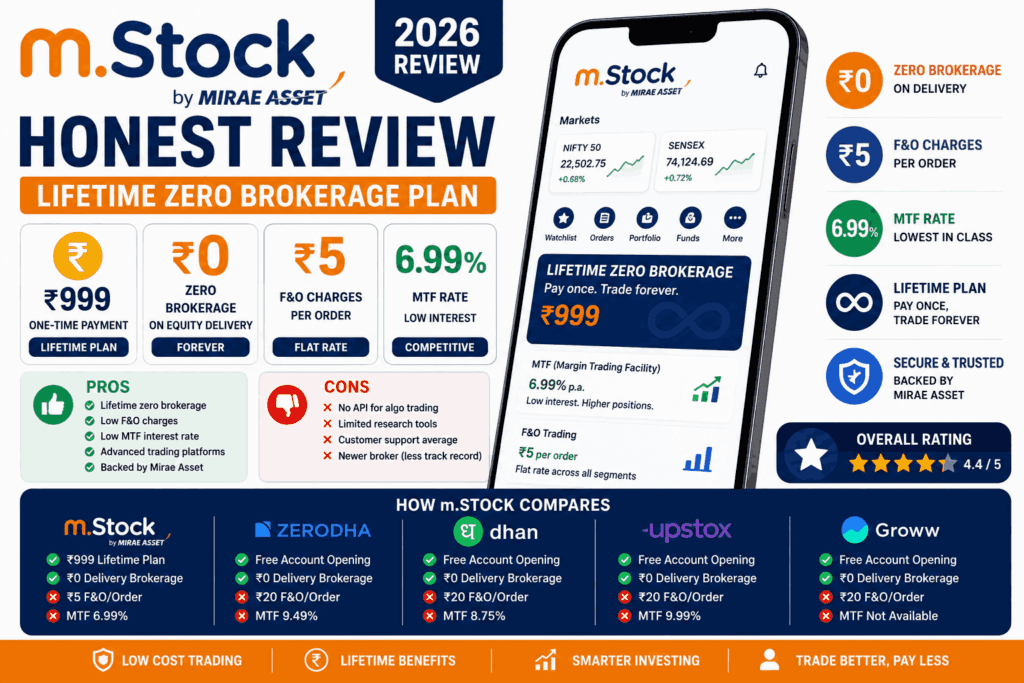
Most Indian discount brokers in 2026 have settled on more or less the same pricing – Rs. 20 per executed order on intraday and F&O, free equity delivery. m.Stock by Mirae Asset broke that consensus three years ago with a structurally different bet: pay Rs. 999 once, and brokerage on most segments becomes either Rs. 5 or zero for life.
That sentence sounds aggressive, and the math behind it is unusual enough that the natural question is whether the broker is gimmicky or whether the offer actually holds up over the years you would use it. We spent two weeks running m.Stock through real trades across delivery, intraday, F&O and MTF, cross-checked every charge against the official pricing page and SEBI broker data, and looked at the user-complaint patterns over the last 12 months to form an opinion.
This m.Stock review covers everything that matters – the two-plan pricing structure, the actual cost math on different trader profiles, MTF and margin offerings, the app reliability concerns that show up in genuine user feedback, security and regulation, and the head-to-head comparison with Zerodha, Groww, Dhan, Upstox and Shoonya. If you are weighing whether to open an m.Stock demat account in 2026, this is the practical guide.
m.Stock’s Rs. 999 lifetime zero brokerage plan is one of the few genuinely differentiated pricing models in Indian broking. Whether it works for you depends entirely on how much you trade – and how much app polish you are willing to trade off.
What is m.Stock? Company overview and credibility
m.Stock is the retail stockbroking platform operated by Mirae Asset Capital Markets (India) Pvt. Ltd. The Indian subsidiary launched the broking arm in April 2022, but the parent group has been in India through Mirae Asset Mutual Fund since 2008 and globally since 1997. Mirae Asset is one of South Korea’s largest financial services groups, managing roughly $600 billion in assets across 15+ countries.
That parentage matters more than people realise. Most newer discount brokers in India – Dhan, Punch Trade, Shoonya – are venture-funded startups, well-funded but operationally young. m.Stock is the only Rs. 5-per-F&O-order broker that runs under a multinational asset manager with three decades of regulated financial services history. For an investor who weighs business-continuity risk seriously, that’s a meaningful structural advantage.
m.Stock at a glance
| Detail | m.Stock 2026 Snapshot |
|---|---|
| Parent company | Mirae Asset Capital Markets (India) Pvt. Ltd. |
| Global parent AUM | ~$600 billion (Mirae Asset Group, Korea) |
| Year launched | April 2022 |
| Headquarters | Mumbai, Maharashtra |
| SEBI registration | INZ000238730 |
| Active clients (NSE) | ~4.6 lakh (as of mid-2025) |
| Account opening fee | Free |
| Demat AMC | Rs. 120 per quarter (or Rs. 999 one-time for lifetime zero AMC) |
| Brokerage model | Two-plan structure: Basic plan or Rs. 999 Zero Brokerage for Life |
| NRI accounts | Not available |
| Mobile platforms | Android & iOS apps; web platform |
| Mutual fund commission | Rs. 0 (direct plans only) |
Active client count, at roughly 4.6 lakh, is small versus the top tier (Groww at ~1.2 crore, Zerodha at ~68 lakh) but the growth rate has been steady since launch. m.Stock is positioning itself not as a beginner’s broker but as a specialist for cost-conscious traders willing to do a one-time upfront commitment.
m.Stock platform overview: app, web and tools
m.Stock offers two trading platforms – a mobile app (Android and iOS) and a web-based terminal. There is no dedicated Windows or Mac desktop client. The platform supports a full range of segments – equity delivery, equity intraday, futures, options, currency derivatives, mutual funds, IPOs and ETFs.
The mobile app
The Android app sits around 4.0-4.2 stars on Google Play depending on the month, with iOS at roughly 4.3 stars. Both apps offer the same core functionality – watchlists, advanced charting, options chain with Greeks, basket orders, and the standard set of order types (market, limit, stop-loss, SL-Market). Users who come from Zerodha Kite generally find m.Stock’s interface more cluttered; users coming from full-service brokers find it more capable.
Charting and order tools
Charting is built on a custom engine with over 100 technical indicators, including the Smart Money Concepts indicators that have become popular with newer traders. You can trade directly from the chart, which is a real workflow advantage. Bracket orders and cover orders are available – genuinely useful for intraday traders who need pre-defined risk parameters.
MIRA – the AI assistant
m.Stock does not provide human relationship managers. Instead, it has built an AI assistant called MIRA that handles account-opening flow, app navigation and basic queries. For straightforward issues, MIRA is competent. For nuanced problems – failed transactions, allocation issues, IPO-related questions – the lack of a human escalation path is one of the bigger weaknesses we’ll touch on later.
Algo trading and APIs
m.Stock offers trading APIs for algorithmic strategies. The API ecosystem is less mature than Zerodha’s Kite Connect – fewer third-party tools integrate with it natively – but it is functional for developers building their own bots and systems.
m.Stock brokerage charges 2026: the two-plan model
This is where m.Stock genuinely differs from everyone else. Rather than the standard “Rs. 20 per order” model, m.Stock offers two plans and lets you pick which one fits your trading style.
Plan 1: The Basic Plan
If you do not pay the Rs. 999 one-time fee, you fall into the Basic plan. Here, equity delivery, mutual funds, IPOs and ETFs are free, and Rs. 20 per order applies to intraday, futures, options, currency derivatives and MTF. This is essentially the standard discount-broker pricing – in line with Zerodha, Dhan, Upstox and Groww. Not particularly competitive against any of them on its own.
Plan 2: Zero Brokerage for Life (Rs. 999 one-time)
Pay Rs. 999 (plus 18% GST = Rs. 1,179) at account opening, and the brokerage structure changes meaningfully. Equity delivery stays free. Mutual funds and IPOs stay free. Everything else – intraday, futures, options, currency, MTF – drops to Rs. 5 per executed order. That’s a 75% reduction from the Rs. 20 industry standard.
| Charge / Feature | Basic Plan | Zero Brokerage Plan (Rs. 999 one-time) |
|---|---|---|
| Equity Delivery | Free | Free |
| Equity Intraday | Rs. 20 per executed order | Rs. 5 per executed order |
| Equity Futures | Rs. 20 per order | Rs. 5 per order |
| Equity Options | Rs. 20 per order | Rs. 5 per order |
| Currency Derivatives | Rs. 20 per order | Rs. 5 per order |
| MTF (Pay Later) | Rs. 20 per order | Rs. 5 per order |
| Mutual Funds (direct) | Free | Free |
| IPO Applications | Free | Free |
| ETFs | Free (delivery) | Free |
| Call & Trade | Free | Free |
| Standard quarterly AMC | Rs. 120 + GST | Rs. 120 + GST (separate Rs. 999 buys lifetime AMC waiver) |
| DP charges (sell) | Rs. 12.50 + GST | Rs. 12.50 + GST |
The Rs. 999 plan is not a brokerage waiver in the literal sense – you still pay Rs. 5 per order on F&O, intraday and MTF. “Zero brokerage” is the marketing line; “Rs. 5 brokerage” is the operational reality. For most active traders, the difference between Rs. 5 and Rs. 20 is what matters.
Lifetime zero AMC: an additional Rs. 999
There is a second lifetime plan worth knowing about. The standard demat AMC at m.Stock is Rs. 120 per quarter (Rs. 480 annually + GST = Rs. 566/year). For an additional one-time Rs. 999 plus GST, you can waive AMC for life. So if you take both plans together – the brokerage one plus the AMC one – you pay roughly Rs. 2,358 (Rs. 1,998 + GST) up front and never pay quarterly AMC or face standard brokerage on any segment again.
Does the Rs. 999 plan actually save you money? The real math
Whether the upfront Rs. 999 makes sense depends entirely on how often you trade. The break-even is straightforward to calculate.
Break-even on F&O brokerage savings alone
At a Rs. 15 savings per F&O order (Rs. 20 minus Rs. 5), the Rs. 999 plan pays for itself after roughly 67 orders. If you place 6 F&O trades a week, you break even in 11 weeks. If you place 20+ F&O orders a month, the plan pays back in three months and saves you serious money over a 1-year horizon. Here’s what cumulative annual savings look like at different volumes:
| F&O Orders / Month | Standard Rs. 20 Broker | m.Stock Zero Plan (Rs. 5) | Annual Savings |
|---|---|---|---|
| 20 | Rs. 4,800 / year | Rs. 1,200 / year | Rs. 3,600 |
| 50 | Rs. 12,000 / year | Rs. 3,000 / year | Rs. 9,000 |
| 100 | Rs. 24,000 / year | Rs. 6,000 / year | Rs. 18,000 |
| 200 | Rs. 48,000 / year | Rs. 12,000 / year | Rs. 36,000 |
| 500 | Rs. 1,20,000 / year | Rs. 30,000 / year | Rs. 90,000 |
Even at modest activity – 20 orders a month – you save Rs. 3,600 a year in brokerage, after paying back the Rs. 999 upfront in under 8 weeks. At 100 orders a month, the savings are Rs. 18,000 a year. For a daily F&O trader running 500 orders a month, you’re effectively saving Rs. 90,000 a year in brokerage alone.
Where the plan does not pay back
If you place fewer than 5-10 F&O orders a month, or you primarily do delivery investing, the Rs. 999 plan does not pay back. Equity delivery is free on the Basic plan anyway, and the Rs. 20-per-order savings on a handful of intraday trades a month does not justify the upfront cost. In this profile, stay on the Basic plan or pick a broker like Dhan or Groww with free delivery and no upfront commitments.
Hidden charges? Statutory and regulatory costs explained
Brokerage is one slice of cost. Like every Indian broker, m.Stock has to pass through statutory charges set by SEBI, the exchanges, the government and the depository. These apply uniformly across brokers – no broker can “waive” them, no matter what the marketing claims.
| Charge | What You Pay (Effective April 2026) |
|---|---|
| STT – Equity Delivery | 0.1% on both buy and sell legs |
| STT – Equity Intraday | 0.025% on sell side only |
| STT – Futures (sell side) | 0.05% (raised from 0.02% effective April 1, 2026) |
| STT – Options (sell side, on premium) | 0.15% (raised from 0.10% effective April 1, 2026) |
| Exchange Transaction Charges | NSE: 0.00297% on equity; F&O varies by product |
| SEBI Turnover Fee | 0.0001% of turnover |
| GST | 18% on brokerage, exchange charges, SEBI fee and DP charges |
| Stamp Duty | 0.015% on delivery buy; 0.003% on intraday buy; 0.002% on futures; 0.003% on options |
| DP charge (sell from demat) | Rs. 12.50 + 18% GST per scrip per day |
| IPF Charge | 0.0001% on NSE turnover |
From April 1, 2026, the government raised STT on futures (from 0.02% to 0.05% on sell) and on options premium (from 0.10% to 0.15% on sell). This is a real cost increase for F&O traders across all brokers. Verify your post-April contract notes.
Two charges to specifically watch on m.Stock:
- DP charges of Rs. 12.50 + GST per scrip on every delivery sell. Lower than Groww’s Rs. 20 but standard for the industry. If you sell from many different scrips in one go, these add up.
- Securities transfer-out fee of Rs. 20 per transaction or 0.50% (whichever lower). Applies if you want to move your demat to another broker. Not unique to m.Stock but worth knowing if you might switch.
MTF (Pay Later / Margin Trading Facility) – m.Stock’s other big differentiator
Margin Trading Facility lets you buy stocks with up to 80% funded by the broker – essentially, leverage on delivery. The cost is the interest rate the broker charges you on the borrowed amount. m.Stock’s MTF rates are among the lowest in Indian broking in 2026.
- Tier 1 (Rs. 25 lakh+ borrowed): 6.99% per annum
- Tier 2 (Rs. 5-25 lakh): 8.99% per annum
- Tier 3 (Rs. 1-5 lakh): 11.99% per annum
- Tier 4 (Below Rs. 1 lakh): 14.99% per annum
Most competitors charge between 12% and 21% per annum on MTF. Zerodha runs roughly 10.5%. m.Stock’s 6.99% tier – though only available for larger borrowing – is genuinely the cheapest in the market right now. The platform also allows unlimited holding period on more than 1,100 stocks under MTF, with no forced sell-off at 30 days or 60 days like some brokers.
MTF is a powerful leverage tool but you are paying interest daily on borrowed capital. The 6.99% rate is attractive only relative to other brokers – in absolute terms, you still need your investment to generate more than that rate of return to be net positive. Don’t use MTF without understanding what you’re paying for.
Security, regulation and trustworthiness
m.Stock is operated by Mirae Asset Capital Markets (India) Pvt. Ltd., a SEBI-registered stockbroker. The standard three-layer protection that applies to every SEBI-registered broker applies here:
- Securities held in your demat account. Your shares sit in your name with CDSL or NSDL – not with m.Stock. Even in the worst case of broker insolvency, your shares stay in your account and can be transferred to another broker.
- Client funds segregation. SEBI’s client-funds-segregation rules require brokers to keep client money in separate bank accounts and true-up settlement bank balances daily.
- Investor Protection Fund. NSE and BSE both run IPF schemes that cover eligible claims up to specified limits in case of broker default.
Beyond the regulatory baseline, the structural credibility of Mirae Asset is the strongest in the discount-broker tier. The Korean parent has been operating for over 30 years; the Indian mutual fund arm has been here since 2008. This is a different risk profile than a venture-funded fintech startup, even one with credible Series B funding.
Standard security features in the app include two-factor authentication, biometric login, encrypted transmission and PAN-tagged account access. The Pledge Margin feature (used in MTF) is regulated under SEBI’s pledge framework and pledged shares remain in your demat account.
m.Stock pros and cons – honest take
What we like
- Lowest F&O brokerage among major brokers (Rs. 5/order on Zero plan, vs Rs. 20 standard)
- Mirae Asset’s institutional backing – 30-year financial services parent, $600B+ global AUM
- Lifetime AMC waiver available (Rs. 999 one-time)
- Industry-leading MTF rates – 6.99% to 14.99% depending on tier
- Unlimited MTF holding period on 1,100+ stocks
- Call & Trade is free – unique among low-cost brokers
- Zero brokerage on mutual funds (direct plans) and IPOs
- Advanced order types – bracket orders and cover orders available
- Algo trading APIs available for developers
What needs work
- App reliability issues – users report freezes and lag during volatile sessions
- Customer support response times can be slow; no relationship manager option
- Quarterly AMC of Rs. 120 unless you pay separate Rs. 999 lifetime waiver
- No NRI account support (as of mid-2026)
- Upfront Rs. 999 commitment is a barrier for casual users
- Smaller active client base (~4.6 lakh) vs top-tier brokers
- No dedicated desktop terminal; web platform is the alternative to mobile
- Third-party tool ecosystem (Sensibull, Streak) less developed than for Zerodha
- Securities transfer-out charge of Rs. 20 or 0.50% if you switch later
m.Stock vs Zerodha, Dhan, Upstox, Groww and Shoonya
Here’s how m.Stock’s Zero Brokerage plan stacks up against the most-considered alternatives in 2026:
| Broker | Delivery | F&O | AMC (yearly) | MTF Rate | Onboarding Cost |
|---|---|---|---|---|---|
| m.Stock (Zero plan) | Free | Rs. 5/order | Rs. 0 (Rs. 999 plan) | 6.99-14.99% | Rs. 999 |
| Zerodha | Free | Rs. 20/order | Rs. 300 | ~10.5% | Rs. 200 |
| Groww | Up to Rs. 20 | Rs. 20/order | Rs. 0 lifetime | ~14% | Free |
| Upstox | Free | Rs. 20/order | Rs. 150-300 | ~18% | Free |
| Dhan | Free | Rs. 20/order | Rs. 0 | ~12.99% | Free |
| Angel One | Free | Rs. 20/order | Rs. 0 (Y1) | ~15.5% | Free |
| Shoonya (Finvasia) | Free | Rs. 5/order | Rs. 0 | ~18% | Free |
m.Stock vs Zerodha
Zerodha has the most reliable execution and the deepest ecosystem (Kite Connect API, Sensibull, Streak, Varsity education). m.Stock has dramatically lower F&O cost (Rs. 5 vs Rs. 20) and significantly lower MTF rates (6.99% vs Zerodha’s 10.5%). For a high-volume F&O trader, m.Stock saves five-figure rupees annually. For a long-term equity investor who values platform polish, Zerodha is the safer pick.
m.Stock vs Dhan
Dhan has zero AMC by default (no upfront fee required), better TradingView integration for options charting, and a more polished app experience. m.Stock counters with lower brokerage on Zero plan (Rs. 5 vs Rs. 20) and significantly lower MTF rates. Dhan is the better choice for active F&O traders who refuse to pay any upfront fees; m.Stock wins on multi-year cost math.
m.Stock vs Upstox
Upstox is a more user-friendly app aimed at the mainstream trader. m.Stock is significantly cheaper on F&O brokerage and on MTF interest. For active traders who can tolerate occasional UX friction in exchange for lower running cost, m.Stock wins. For casual or beginner traders, Upstox is easier.
m.Stock vs Groww
Different audiences. Groww optimises for simplicity and is the absolute best starting point for first-time investors – zero AMC always, no upfront commitment, the cleanest UI in Indian broking. m.Stock is built for traders who already know what they want and want to minimise cost over many years. Pick Groww if you are starting out; pick m.Stock if you are an active F&O or MTF trader.
m.Stock vs Shoonya (Finvasia)
This is the closest cost comparison. Both offer Rs. 5/order on F&O. Shoonya has zero AMC always and zero upfront cost – lower commitment. m.Stock has Mirae Asset’s institutional backing, dramatically lower MTF rates (6.99% vs Shoonya’s ~18%), and a more polished app. If you need MTF, m.Stock is the better economic choice. If you do not need MTF and want the lowest-friction setup, Shoonya wins.
Who should open an m.Stock account – and who should skip it
m.Stock is a strong fit for
- Active F&O traders placing 20+ orders per month who can pay Rs. 999 upfront
- Intraday traders looking for lower per-trade cost than the Rs. 20 standard
- MTF users who want to leverage their portfolio at the lowest interest rate in India
- Cost-conscious traders willing to trade off some UX polish for meaningful savings
- Investors who value institutional backing from a large global parent
- Multi-year traders who plan to use the same broker for at least 2-3 years
You should probably skip m.Stock if
- You are a complete beginner – Groww or Zerodha give you a smoother first experience
- You place fewer than 5 F&O orders a month – upfront Rs. 999 will not pay back
- You are a long-term equity investor only – free delivery is available everywhere
- You are an NRI – m.Stock does not currently support NRI accounts
- App stability is your top priority – Zerodha Kite is more dependable in high-volume sessions
- You value premium customer support and human relationship managers
- You depend on third-party tools – Zerodha’s ecosystem is broader
Latest 2026 updates and platform changes
Notable changes affecting m.Stock users in 2026:
- Higher STT on F&O (April 2026): Futures STT raised to 0.05% on sell side; options STT raised to 0.15% on sell premium. These are government taxes, identical at every broker – not m.Stock specific. Active F&O traders should reprice their break-even calculations.
- MTF tier rates kept stable: m.Stock has maintained its 6.99-14.99% MTF rate band through 2025 and into 2026, even as some competitors raised rates.
- Continued app updates: The development team has been releasing roughly one major app update per quarter. Many of the early app stability complaints from 2023-2024 have been partially addressed, though not fully resolved.
- No new products launched: Unlike some competitors expanding into US stocks, NPS or insurance, m.Stock has stayed focused on Indian equity, F&O, MTF and mutual funds. NRI accounts remain absent.
Frequently Asked Questions
Q1. Is m.Stock review consensus positive in 2026?
Mostly yes – m.Stock review consensus across major comparison sites and independent reviewers has been positive, particularly on its pricing model and Mirae Asset’s institutional backing. The most common reservations relate to app reliability and customer-support response time. The overall rating across reviewers tends to land at 4.0-4.3 out of 5.
Q2. Is m.Stock safe to use?
Yes. m.Stock is operated by Mirae Asset Capital Markets (India) Pvt. Ltd., a SEBI-registered stockbroker. Your shares are held in CDSL or NSDL under your own name and PAN, client funds are segregated per SEBI norms, and Investor Protection Fund coverage applies. The parent group, Mirae Asset, has been a global financial services firm for over 30 years.
Q3. What is the real m.Stock brokerage in 2026?
On the Basic plan: equity delivery is free, while intraday, futures, options, currency and MTF are Rs. 20 per executed order. On the Rs. 999 Zero Brokerage for Life plan: equity delivery, mutual funds and IPOs remain free, while intraday, futures, options, currency and MTF drop to Rs. 5 per order. The Rs. 999 plan is a one-time payment that applies to the account for life.
Q4. Is the m.Stock Rs. 999 plan worth it?
Worth it for active traders – the break-even is roughly 67 F&O orders, achievable within 2-3 months if you trade actively. Not worth it for casual investors or pure long-term equity buyers, since equity delivery is free on the Basic plan anyway. Calculate your expected F&O / intraday volume over a 12-month period and check if the cumulative Rs. 15-per-order savings exceed Rs. 999.
Q5. Does m.Stock have hidden charges?
m.Stock has no hidden charges beyond what is documented on its pricing page. The standard quarterly AMC of Rs. 120 (Rs. 480/year) applies unless you pay an additional Rs. 999 for lifetime AMC waiver. DP charges of Rs. 12.50 + GST apply on every delivery sell. Statutory charges (STT, GST, stamp duty, exchange fees) apply uniformly across all Indian brokers, not specific to m.Stock.
Q6. How does m.Stock compare with Zerodha?
Zerodha is the more reliable platform with a deeper ecosystem – Kite Connect API, Sensibull integration, Streak algo trading, Varsity education. m.Stock is significantly cheaper on F&O (Rs. 5 vs Rs. 20 per order) and on MTF rates (6.99% vs ~10.5%). For an active F&O trader, m.Stock saves five-figure rupees annually. For a long-term investor who values platform polish, Zerodha is the safer pick.
Q7. Does m.Stock offer a desktop trading terminal?
No dedicated Windows or Mac desktop terminal. The platform offers a mobile app (Android and iOS) and a web-based terminal accessible via any browser. For heavy-terminal traders accustomed to multi-monitor setups, this is a notable limitation.
Q8. What are m.Stock’s MTF (Pay Later) rates?
m.Stock charges 6.99% per annum on borrowings above Rs. 25 lakh, 8.99% on Rs. 5-25 lakh, 11.99% on Rs. 1-5 lakh, and 14.99% below Rs. 1 lakh. These are among the lowest MTF rates in Indian broking in 2026. Most competitors charge between 12% and 21%. Unlimited holding period applies on more than 1,100 eligible stocks.
Q9. Can NRIs open an m.Stock account?
No. As of mid-2026, m.Stock does not support NRI accounts. NRI investors looking for low-cost brokers should consider Angel One, Zerodha or Shoonya, all of which have established NRI account services.
Q10. How long does m.Stock account opening take?
The application is fully online and typically takes 15-30 minutes of active effort. Aadhaar e-KYC, video IPV (in-person verification) and bank-account linking happen digitally. Account activation generally completes in 24-48 hours. You will need PAN, Aadhaar (linked to your mobile), a bank account proof, and a recent income document if you plan to trade in F&O.
Final verdict
m.Stock is one of the most differentiated discount-broker offerings in India in 2026 – and like every genuinely differentiated product, it’s an outright winner for some users and a poor fit for others. The honest answer to “should I open an m.Stock account?” depends on whether the pricing math works for your actual trading volume and whether you are willing to accept some app polish trade-offs for meaningful cost savings.
Three takeaways from our m.Stock review:
- The Rs. 999 plan is the entire value proposition. Without it, m.Stock is a standard Rs. 20-per-order broker with no compelling reason to choose over Zerodha or Dhan. With it, m.Stock becomes one of the cheapest active-trading setups in India – particularly when combined with the industry-low MTF rates.
- Mirae Asset backing is real, but not infallible. The institutional parentage is the strongest among low-cost brokers, but it does not exempt the app from the reliability issues that genuinely show up in user feedback. The platform works; it just works less smoothly than Zerodha Kite during peak volatility.
- MTF is the underrated differentiator. If you use Margin Trading Facility – even occasionally – m.Stock’s 6.99-14.99% rate band saves you serious interest costs versus the 12-21% most competitors charge. This often gets overlooked next to the headline brokerage figures, but it can be the biggest financial advantage for MTF-using traders.
If you are an active F&O or MTF trader who can commit to using a broker for at least 2-3 years, m.Stock’s Rs. 999 plan delivers real savings. If you are a beginner, a casual investor, or someone who needs premium customer support, look elsewhere first. The right broker is the one whose strengths and weaknesses match how you actually trade – not the one with the loudest pricing line.
m.Stock works best when you understand exactly what you are paying for – and what you are not. A Rs. 999 commitment in exchange for Rs. 5 brokerage and 6.99% MTF rates is not the cheapest option for everyone, but it can be one of the most economical for the right trader profile.
