
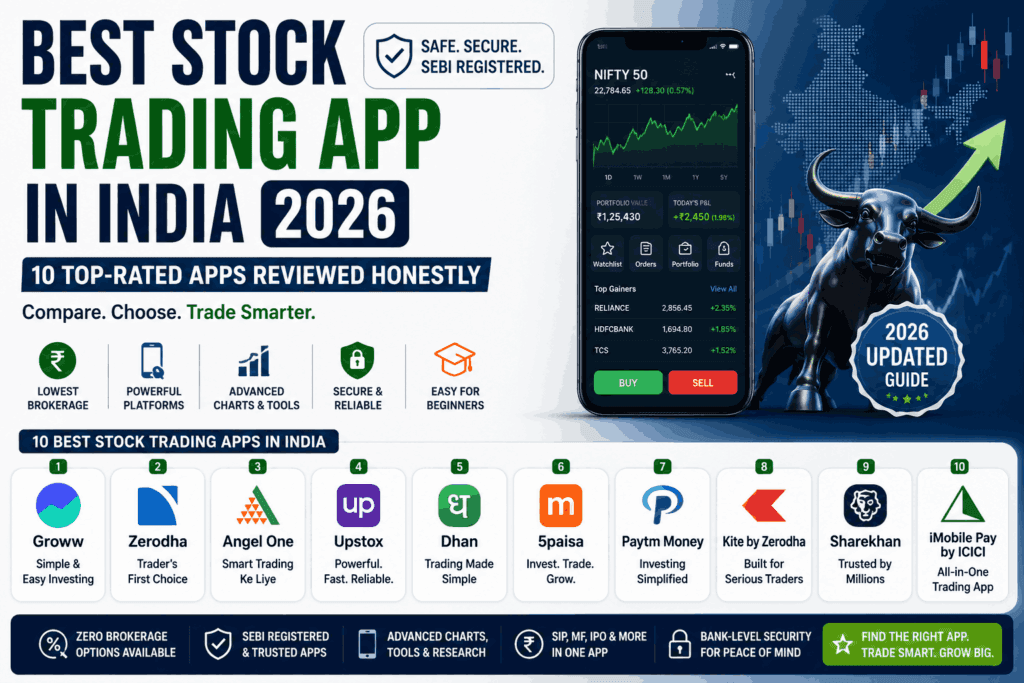
India crossed 16 crore demat accounts in 2026, and somewhere between 80 and 90 percent of those are operated almost exclusively through a phone. The desktop trading terminal is not dead, but it has become the exception. For most retail investors today, the choice of stock trading app is the single most consequential financial-software decision they will make – it shapes how much brokerage they pay, how quickly their orders fill, and how comfortable they feel logging in every morning.
This is an independent look at the best stock trading app in India for 2026, built around hands-on use of every app on the list, public SEBI data, and the actual brokerage and AMC rates currently disclosed by each broker. We have not ranked these apps in a strict hierarchy because the right app for a long-term mutual-fund SIP investor is almost never the right app for a daily F&O trader. Instead, we walk through 10 platforms, what each one does best, and who should pick which.
If you read just one section, make it the decision framework toward the end – the rest is detail.
All SEBI-registered brokers in India operate under the same investor-protection framework. Your shares sit in your name in CDSL or NSDL, and your funds are segregated. The choice is about experience, cost and fit, not safety.
Why your stock trading app matters more than you think
A trading app is not a neutral tool. The platform you log into every day shapes three things that quietly compound over years:
1. Friction with your own decisions
A clean app encourages you to think clearly. A cluttered app tempts you to over-trade. A confusing app makes you avoid action when you should be acting. The behavioural cost of a bad app shows up in your portfolio long before it shows up in your reviews.
2. Real money in brokerage and AMC
Standard discount brokerage in India in 2026 is Rs. 20 per order on intraday and F&O. Some apps charge zero AMC, some charge Rs. 700+ per year. Across 10 years and an active trading account, the difference between the cheapest and most expensive setups is easily Rs. 50,000-1,00,000. Not life-changing money, but not trivial either.
3. Execution speed and uptime
On Budget day, the day the Fed surprises markets, or any session where Nifty moves 200 points in 10 minutes, the difference between an app that holds up and one that crashes is the difference between being a trader and being a spectator. Order-execution latency in milliseconds matters more than most retail investors realise.
Best stock trading apps in India 2026 – the shortlist
Here are the 10 apps we evaluated, with the headline data first. Active client numbers are based on April-May 2026 NSE/BSE disclosures and may vary slightly month to month.
| Rank | App | Best For | Active Clients* | Delivery / F&O Brokerage |
|---|---|---|---|---|
| 1 | Groww | Beginners & SIP investors | ~1.21 crore | Free / Rs. 20 |
| 2 | Zerodha Kite | Active traders, intraday | ~68 lakh | Free / Rs. 20 |
| 3 | Angel One | Research-led investors | ~67-75 lakh | Free / Rs. 20 |
| 4 | Upstox | Mobile-first traders | ~27 lakh | Free / Rs. 20 |
| 5 | Dhan | F&O & options traders | ~10 lakh+ | Free / Rs. 20 |
| 6 | ICICI Direct | 3-in-1 banking + research | ~50 lakh+ | Slab-based / Slab |
| 7 | 5paisa | Cost-conscious traders | ~6 lakh+ | Rs. 20 / Rs. 20 |
| 8 | m.Stock by Mirae | Lifetime zero brokerage | ~5 lakh+ | Free / Free (with Rs. 999 plan) |
| 9 | Paytm Money | Existing Paytm ecosystem | ~5 lakh+ | Free / Rs. 20 |
| 10 | Kotak Neo | Under-30 traders, Kotak customers | ~5 lakh+ | Free for under-30 / Rs. 20 |
*Active client counts reflect NSE active client base as of April-May 2026, sourced from publicly disclosed broker rankings. Numbers shift monthly; always verify before opening an account.
Detailed reviews – 10 best stock trading apps in India
1. Groww – best for beginners and SIP investors
Groww overtook Zerodha as India’s largest broker by active clients in 2024 and has held that lead through 2026. It now operates around 1.21 crore active accounts – roughly 27 percent of NSE’s active client base. The lead is not an accident. Groww has obsessed over one thing: making the stock market understandable to someone who has never opened a demat account before.
The app’s onboarding takes under five minutes via Aadhaar e-KYC. The home screen does not assume you know what a P&L statement is. Mutual funds, stocks, IPOs and digital gold sit side by side rather than buried behind menus. For a first-time investor, the friction is almost zero.
Brokerage: Free equity delivery, Rs. 20 per order on intraday and F&O.
Account opening: Free.
Demat AMC: Rs. 0.
Best for: First-time investors, SIP-led mutual fund buyers, simple long-term investing.
Pros
- Cleanest and most beginner-friendly UI in Indian broking
- Truly zero AMC and free account opening – no hidden cost layer
- Integrated stocks + mutual funds + IPOs + US stocks in one app
- Largest active client base in India – good liquidity-of-network for problem-solving
Cons
- Charting tools are basic compared with Zerodha or Dhan
- No API access for algo trading
- Customer support depth lags Zerodha; community is more crowded
- Slippage during high-volume sessions occasionally reported by active traders
2. Zerodha Kite – best for active traders
Zerodha created the discount-broking category in India and Kite remains the gold standard for everyday active trading. The app is clean, fast, and built around the workflows actual traders use – not a marketing team’s idea of what a trader needs. The Kite Connect API has become the most-used algo-trading API in India, powering thousands of independent trading bots and analytics platforms.
Zerodha lost the top spot in client count to Groww but remains the most respected name among serious traders. Its Varsity education portal is the single best free trading-education resource in India.
Brokerage: Free equity delivery, Rs. 20 per order on intraday and F&O.
Account opening: Rs. 200.
Demat AMC: Rs. 300 per year.
Best for: Intraday traders, F&O traders, algo developers, anyone who values reliability.
Pros
- Most reliable platform during high-volume market events
- Best API ecosystem in Indian broking (Kite Connect)
- Varsity is the deepest free education library among Indian brokers
- Strong third-party tool integration (Sensibull, Streak, etc.)
Cons
- Mutual funds live in a separate app (Coin) – inconsistent with rivals
- Higher AMC than the zero-AMC competitors
- UI feels conservative compared with newer entrants like Dhan
- API access for retail bots is paid (around Rs. 2,000 per month)
3. Angel One – best for research-led investors
Angel One bridges the discount-broker and full-service-broker worlds better than anyone else in 2026. You get the Rs. 20-per-order pricing of a discount broker, but you also get research reports, ARQ Prime AI recommendations and a relationship-manager option for premium clients. The company crossed 75 lakh active clients in early 2026, making it one of the three largest brokers in India.
Brokerage: Free equity delivery, Rs. 20 per order on intraday and F&O.
Account opening: Free.
Demat AMC: Rs. 0 first year, then nominal.
Best for: Investors who want research and recommendations alongside execution.
Pros
- In-house research reports and ARQ AI recommendations included
- Free equity delivery plus a wide product mix (commodities, currencies, bonds)
- SmartAPI is a solid algo-trading alternative to Kite Connect
- Strong customer support network with phone and branch presence
Cons
- App can feel busy compared with Groww or Kite
- Quality of automated recommendations varies and should not replace your own analysis
- Occasional cross-sell prompts into adjacent products
- Mobile app charting trails Zerodha and Dhan on advanced features
4. Upstox – best mobile-first experience
Upstox is the third-largest among the new-age discount brokers, with around 27 lakh active clients in 2026. Backed by Ratan Tata and Tiger Global, RKSV Securities built Upstox around a single conviction – mobile-first traders deserve an app that does not lag during market opens. The TradingView integration is one of the best in Indian broking.
Brokerage: Free equity delivery, Rs. 20 per order on intraday and F&O.
Account opening: Free.
Demat AMC: Rs. 150-300 per year.
Best for: Casual-to-active traders who want a polished mobile experience.
Pros
- Fast, responsive mobile app with TradingView charts built-in
- Strong order-execution speed – among the best in the category
- Clean UI that suits both beginners and intermediate traders
- Algo trading via Upstox API
Cons
- Customer support response time can be slow during peak market hours
- App has had occasional downtime during high-volatility sessions
- Call & trade fees are high (around Rs. 50)
- Education content is thinner than Zerodha’s Varsity
5. Dhan – best F&O and options trading app
Dhan is the most technically-impressive trading app launched in India since Zerodha started Kite. Founded in 2021 by former Paytm Money and Zerodha alumni, it focuses obsessively on active traders, especially in F&O and options. The platform integrates TradingView at a depth no other Indian app matches and was awarded TradingView’s “Best Broker APAC” in 2023 and 2024.
Brokerage: Free equity delivery, Rs. 20 per order on intraday and F&O.
Account opening: Free.
Demat AMC: Rs. 0.
Best for: Active F&O traders, options strategists, scalpers.
Pros
- Deepest TradingView integration among Indian brokers
- Best-in-class options chain with live Greeks and OI data
- Basket orders and Flash Trade for multi-leg options strategies
- Zero AMC and free equity delivery
- DhanHQ API for algo traders
Cons
- Overwhelming for beginners – learning curve is steep
- Customer support during major outages has been mixed historically
- Smaller client base than the top 3 – less third-party tool support
- App can feel cluttered when many features are enabled simultaneously
6. ICICI Direct – best 3-in-1 banking integration
ICICI Direct is the largest full-service broker in India and still one of the most trusted platforms for traditional investors. The pull is not pricing – brokerage runs higher than the discount-broker average – but the 3-in-1 account that links your ICICI savings account, demat and trading seamlessly. For investors who value depth of research and bank-grade integration over absolute lowest cost, ICICI Direct remains a leading choice.
Brokerage: Slab-based (~0.55% delivery) or Neo plan with flat fees.
Account opening: Free with select plans.
Demat AMC: Rs. 700+ per year.
Best for: ICICI Bank customers, investors who want one-tap fund movement, research-led investors.
Pros
- Seamless 3-in-1 integration with ICICI Bank
- Strongest research reports in the broker landscape
- Access to US stocks via the Global Investing module
- Highly reliable platform – infrastructure backed by ICICI
Cons
- Higher brokerage than every discount broker on this list
- AMC is the highest in our comparison
- Mobile app feels dated compared with newer rivals
- Plan structures can be confusing – read the fine print
7. 5paisa – cost-conscious active trader
5paisa, part of IIFL Securities, was the original disruptor pre-Zerodha era. It still maintains a small but committed base of cost-conscious traders. The brokerage model charges Rs. 20 per order across both delivery and intraday, which is unusual – most discount brokers waive delivery brokerage now – but the plan-based pricing structure gives high-volume traders some optionality.
Brokerage: Rs. 20 per order across segments (subscription plans available).
Account opening: Free.
Demat AMC: Plan-dependent (Rs. 0 – Rs. 300).
Best for: Traders who place a high volume of small orders.
Pros
- Subscription plans can lower per-order cost for active traders
- Backed by IIFL – long operating history and credibility
- US stocks access via Vested integration
- Algo trading APIs available
Cons
- Charges Rs. 20 on delivery while most rivals waive it – costs more for long-term investors
- App quality lags Groww, Dhan and Upstox
- Customer support has been hit-or-miss in user reviews
- Plan complexity makes it hard to forecast true monthly cost
8. m.Stock by Mirae Asset – lifetime zero brokerage
m.Stock made a genuinely novel pricing bet – pay a one-time Rs. 999 and never pay brokerage again, on any segment, for life. For active traders who plan to stay in markets for decades, the math works out remarkably well. Backed by Korea’s Mirae Asset, the platform has steadily grown its active client base since launch.
Brokerage: Free across all segments with Rs. 999 one-time plan; otherwise standard rates.
Account opening: Free.
Demat AMC: Rs. 0 lifetime.
Best for: Active long-term traders, MTF users, anyone running the multi-year math.
Pros
- Unique lifetime zero brokerage plan saves real money for high-volume traders
- Margin Trading Facility starting at competitive rates (6.99% p.a.)
- Real-time tick-by-tick market data
- Lifetime Rs. 0 demat AMC
Cons
- Rs. 999 upfront cost is meaningless for casual users who barely trade
- Charting tools are functional but not at TradingView depth
- No US stocks or international markets
- Smaller third-party tool ecosystem than Zerodha or Dhan
9. Paytm Money – best for the Paytm ecosystem
Paytm Money sits at an interesting crossroads in 2026. The app itself is clean and capable, with free equity delivery and Rs. 20-per-order intraday/F&O brokerage. The pull is the deep integration with Paytm’s broader payments ecosystem – if you already live inside Paytm for UPI and bill payments, the friction to invest is minimal. The catch is the company’s regulatory journey through 2024-2025, which has narrowed some product offerings.
Brokerage: Free equity delivery, Rs. 20 per order on intraday and F&O.
Account opening: Free.
Demat AMC: Rs. 0.
Best for: Existing Paytm users who want to consolidate finance in one app.
Pros
- Tight integration with the Paytm ecosystem – one-tap fund transfer
- Free equity delivery and zero AMC
- Clean app with strong onboarding flow
- Mutual funds and stocks under one roof
Cons
- Smaller active client base reduces network effects
- Regulatory uncertainty around the parent has hurt user trust
- Charting tools are basic
- No algo / API support
10. Kotak Neo – best for under-30 traders with Kotak banking
Kotak Neo took an unconventional pricing route in 2024 – free intraday and futures brokerage for traders under 30 years old (with a small annual cap). For young Kotak Mahindra Bank customers, this is one of the best deals in Indian broking. For everyone else, the value proposition is more conventional – a competent discount broker with the credibility of one of India’s top private banks behind it.
Brokerage: Free for under-30; Rs. 20 per order otherwise.
Account opening: Free.
Demat AMC: Rs. 0 on the basic plan.
Best for: Kotak Mahindra Bank customers, traders under 30.
Pros
- Free intraday and futures brokerage for under-30 users
- Backed by Kotak Mahindra Bank – strong trust signal
- Tight banking integration for Kotak account holders
- Reasonable charting and order types
Cons
- If you do not bank with Kotak, the integration benefit disappears
- Brokerage on options is not free even for under-30 users
- Mobile app polish trails Groww, Zerodha and Dhan
- Smaller ecosystem of third-party integrations
Brokerage and AMC compared – 2026 rates
Here is the side-by-side cost picture for all 10 apps. These are the rates a typical retail trader will see on the standard plan; some apps offer subscription-based variants that change the per-order cost meaningfully.
| App | Account Opening | Demat AMC (yearly) | Equity Delivery | Intraday / F&O |
|---|---|---|---|---|
| Groww | Free | Rs. 0 | Free | Rs. 20 per order |
| Zerodha Kite | Rs. 200 | Rs. 300 | Free | Rs. 20 per order |
| Angel One | Free | Rs. 0 (1st year) | Free | Rs. 20 per order |
| Upstox | Free | Rs. 150-300 | Free | Rs. 20 per order |
| Dhan | Free | Rs. 0 | Free | Rs. 20 per order |
| ICICI Direct | Free / paid plans | Rs. 700+ | Slab (0.55%) | Slab-based |
| 5paisa | Free | Rs. 0-300 (plan-based) | Rs. 20 per order | Rs. 20 per order |
| m.Stock (Rs.999 plan) | Rs. 999 one-time | Rs. 0 lifetime | Free | Free |
| Paytm Money | Free | Rs. 0 | Free | Rs. 20 per order |
| Kotak Neo | Free | Rs. 0 (basic) | Free (under-30) | Rs. 20 per order |
Statutory charges – STT, exchange transaction charges, SEBI turnover fee, stamp duty, GST and DP charges on delivery sells – apply uniformly across all brokers and are not broker-specific.
Feature comparison – what each app actually supports
| App | Mutual Funds | IPO | F&O | US Stocks | API / Algo |
|---|---|---|---|---|---|
| Groww | Yes | Yes | Yes | Yes | No |
| Zerodha Kite | Via Coin | Yes | Yes | No (paused) | Yes (Kite Connect) |
| Angel One | Yes | Yes | Yes | No | Yes (SmartAPI) |
| Upstox | Yes | Yes | Yes | No | Yes (Upstox API) |
| Dhan | Yes | Yes | Yes | No | Yes (DhanHQ) |
| ICICI Direct | Yes | Yes | Yes | Yes (Global) | Yes (Breeze API) |
| 5paisa | Yes | Yes | Yes | Yes (Vested) | Yes |
| m.Stock | Yes | Yes | Yes | No | No |
| Paytm Money | Yes | Yes | Yes | Yes (historical) | No |
| Kotak Neo | Yes | Yes | Yes | Yes | Yes (Neo API) |
How to choose the best stock trading app for you in 2026
There is no objectively best app, only the right app for your trading style. Run through these filters in order:
| What to check | Why it matters |
|---|---|
| SEBI registration & exchange membership | Confirms the broker is regulated. Verify on SEBI’s intermediary portal before opening an account. |
| Brokerage on intraday & F&O | The Rs. 20-per-order standard adds up. For 50 orders/day, even Re. 1 difference per order is Rs. 6,000+ a year. |
| Annual demat AMC | Ranges from Rs. 0 (Dhan, Groww) to Rs. 700+ (full-service brokers). Recurring cost worth comparing. |
| Order execution speed | Matters most in F&O and intraday. Look for sub-100ms execution and a published status page. |
| Charting quality (TradingView/native) | Active traders need usable charts. TradingView integration is the gold standard. |
| Mobile app stability | Check Play Store ratings filtered by ‘recent’ – daily users will tell you the truth. |
| Mutual fund + IPO + bonds support | If you want one app for everything, breadth matters. Dedicated traders may not need this. |
| Customer support channels | Phone, chat, email, in-app ticketing. Test response time before you actually need them. |
| Capital safety mechanisms | Shares in CDSL/NSDL under your own name, client funds segregation, Investor Protection Fund coverage. |
If you are a complete beginner
Start with Groww. The simplicity removes friction from learning, the zero AMC and free account opening mean you can begin without committing money to the broker, and you can always switch later as your needs evolve. Pair it with mutual fund SIPs to build a habit rather than chasing trades.
If you are an active intraday or F&O trader
Zerodha Kite or Dhan. Zerodha for the depth of the ecosystem, the most reliable execution under high volume, and the third-party tool support (Sensibull, Streak). Dhan for the deeper TradingView integration, the better options chain and the lower AMC. Both are excellent – the choice comes down to whether you value ecosystem maturity (Zerodha) or product depth for options (Dhan).
If you want research alongside execution
Angel One. The combination of discount-broker pricing with bundled research reports and AI recommendations is unique in the Rs. 20 tier. Be selective about which research you act on – the volume can be overwhelming and not every recommendation is high-conviction.
If you bank with ICICI, HDFC or Kotak
Use their broker. The 3-in-1 banking integration removes a meaningful amount of friction in fund movement and reconciliation. ICICI Direct has the strongest research, HDFC Securities has solid app polish, Kotak Neo has the under-30 deal. Trade some yield for convenience.
If you are very cost-conscious and trade a lot
m.Stock’s Rs. 999 lifetime plan. Run the math – if you place more than 50 trades per year, the payback is under two years. Beyond that, every order is genuinely free.
If you want to build trading bots
Zerodha Kite Connect for the documentation depth and community support, or Angel One SmartAPI as a solid alternative. Both have Python and Java SDKs that work. Avoid relying on smaller-broker APIs unless you are prepared to maintain your own integration.
Security, regulation and what “safety” actually means
All 10 apps on this list are SEBI-registered stockbrokers. That common foundation matters more than most retail investors realise. Three layers protect your money in every case:
- Shares held in your own name. Your demat account is with CDSL or NSDL – the central depositories – not with the broker. Even if the broker shuts down, your shares stay in your account and can be transferred to another broker via a standard DIS form or the CDSL Easiest portal.
- Funds segregation. SEBI rules require client funds to be kept in separate bank accounts from the broker’s own funds. Daily settlement true-ups are mandatory. The broker cannot use your money for their own business.
- Investor Protection Fund. Both NSE and BSE run Investor Protection Funds that cover eligible claims up to specified limits in case of broker default.
Beyond the legal framework, the security checklist for any trading app should include:
- Two-factor authentication on every login – mandatory now under SEBI rules
- Biometric login on the app (fingerprint or face ID)
- Encrypted data transmission (TLS 1.2 or higher)
- Published system-status page showing uptime and execution metrics
- Clear grievance redressal channel and SEBI SCORES portal access
If a trading app does not enforce 2FA at login, or promises guaranteed returns in any messaging, treat both as serious red flags and report via SEBI’s SCORES portal.
What changed in the Indian trading-app landscape in 2026
Three updates from 2025-2026 deserve attention from anyone choosing or switching apps:
Higher STT on F&O after Budget 2024
The Securities Transaction Tax on futures and options trades was hiked in Budget 2024 and continues in 2026. STT on futures is 0.02% on the sell side, and on options it is 0.10% on the premium – both higher than pre-Budget rates. This is a statutory charge applied uniformly across all brokers, but the cumulative cost increase for active F&O traders is meaningful and worth modelling before you decide on trade volume.
New tax regime is default; ELSS Section 80C only under old regime
The new tax regime became the default in 2024, and most salaried filers in 2026 are filing under it. This affects mutual fund SIP planning because Section 80C deductions (which made ELSS attractive) are not available under the new regime. If you have actively chosen to stay on the old regime, ELSS still gives you a deduction. Otherwise, treat ELSS like any other equity fund.
LTCG and STCG rates updated
Equity long-term capital gains are now taxed at 12.5% on gains exceeding Rs. 1.25 lakh per financial year (the exemption was raised from Rs. 1 lakh). Short-term gains are taxed at 20% (up from 15%). The holding-period threshold remains 12 months for equity. These rates apply across every broker on this list – the choice of app does not change your tax position.
Tighter conflict-of-interest segregation
SEBI has tightened the segregation rules between brokers’ advisory arms and their distribution businesses. If your trading app is part of a larger financial-services group offering mutual funds or insurance, expect more disclosures and explicit consent forms when cross-product offers appear.
Mistakes to avoid when picking a trading app
1. Chasing the lowest brokerage at any cost
Saving Rs. 5 per order is meaningless if the app crashes during the market open you cared about. Reliability has a price, and for active traders it is worth paying it.
2. Ignoring the AMC
A Rs. 700 annual demat AMC over 20 years is Rs. 14,000 just to hold an account. The cost is not in any single year – it is in the cumulative drag on a long-term investing journey.
3. Falling for promotional brokerage rates
First-year free, then standard. Read the price-after-promo before opening the account. Most brokers will be honest about this in the fine print – investors miss it.
4. Opening too many demat accounts
Three is a sensible upper limit – one primary and at most two secondary. Beyond that, you fragment your holdings, lose track of dividends and dilute the tax-reporting clarity that matters at year-end.
5. Trusting Play Store ratings without filtering
Filter reviews by “most recent” and read the one-star reviews – that is where outages, withdrawal delays and customer-support failures get documented. Five-star reviews from years ago are useless.
6. Picking an app for features you will not use
A casual investor does not need an algo-trading API. A long-term mutual fund SIP investor does not need a fancy options chain. Match the feature set to what you will actually use – the bloat costs you UI clarity, not money, but it costs you.
Frequently Asked Questions
Q1. Which is the best stock trading app in India in 2026?
There is no single best app – the right choice depends on what you trade and your experience level. Groww is the best for beginners and SIP investors, Zerodha Kite and Dhan are the best for active intraday and F&O traders, Angel One is best for research-led investors, and m.Stock’s Rs. 999 lifetime plan is best for high-volume traders running the long-term cost math. All 10 apps on this list are SEBI-registered and safe.
Q2. Which is the best trading app for beginners in India?
Groww. The clean UI, fast onboarding, zero AMC and free equity delivery make it the lowest-friction entry into Indian markets. The interface does not assume you understand market jargon, and you can graduate to more complex apps like Zerodha or Dhan once you have a year or two of experience.
Q3. Are stock trading apps in India safe?
Yes, all SEBI-registered apps are safe in the legal-framework sense. Your shares are held in CDSL or NSDL under your own name, your funds are segregated as per SEBI rules, and Investor Protection Fund coverage applies on eligible claims. Always verify the broker’s SEBI registration on the official portal, enable two-factor authentication, and never share your login credentials with anyone.
Q4. Which app has the lowest brokerage in India in 2026?
For one-off use, Groww, Zerodha, Angel One and Dhan all offer free equity delivery and Rs. 20 per order on intraday and F&O. For high-volume users, m.Stock’s Rs. 999 one-time plan provides truly zero brokerage across all segments for life – the cheapest setup if you plan to trade frequently for many years.
Q5. Which app is the best for intraday trading?
Zerodha Kite and Dhan are the top picks. Zerodha for the reliability of order execution during high-volume sessions, the deep third-party tool integration (Sensibull, Streak), and the Kite Connect API. Dhan for the TradingView-powered charting, faster order workflow and the better options chain. Both share the Rs. 20-per-order standard.
Q6. Which app is the best for F&O and options trading?
Dhan. The TradingView integration is the deepest among Indian brokers, the options chain shows live Greeks and OI data, the basket-orders and Flash Trade features let you execute multi-leg strategies quickly, and the platform was awarded TradingView’s “Best Broker APAC” in both 2023 and 2024. Zerodha is a strong second because of Sensibull integration.
Q7. Can I open multiple demat accounts across these apps?
Yes, you can open demat accounts with multiple brokers. Many investors split their portfolio – one broker for long-term investing, another for active trading. Keep the number manageable (three accounts is generally sufficient) to avoid fragmenting your holdings and complicating tax reporting at year-end.
Q8. Do these apps support mutual fund SIPs?
Most of them do. Groww, Angel One, Upstox, Paytm Money and Kotak Neo offer mutual funds within the same app. Zerodha runs mutual funds through its sister app Coin. The major exception is some pure-trading apps that focus on equity execution and treat mutual funds as a secondary offering.
Q9. Which apps support US stock trading from India?
Groww, Angel One, ICICI Direct, 5paisa (via Vested integration) and Kotak Neo all offer US stocks access. Coverage varies – Groww’s offering is among the simplest, while ICICI Direct’s Global Investing module is the most established. Note that international investing is subject to the RBI’s Liberalised Remittance Scheme (LRS) limit of $250,000 per financial year per individual.
Q10. What documents do I need to open a trading account through an app?
PAN card, Aadhaar (linked to your mobile number for OTP-based e-KYC), a bank account proof (cancelled cheque or bank statement page showing account number and IFSC), and a recent income proof if you plan to trade in F&O (salary slip, ITR or bank statement). The entire process is digital, takes under 30 minutes of active effort, and most apps activate the account within 24-48 hours.
Final verdict
The best stock trading app in India in 2026 is not a single app – it is the app that fits how you actually invest or trade. The good news is that the gap in quality between the top apps has narrowed dramatically. Pricing has converged on Rs. 20 per order. Free equity delivery is the norm. Most apps now offer competent charting, mutual funds and IPOs.
That makes the choice less about absolute capability and more about fit. Three takeaways worth holding on to:
- Match the app to your use case, not to its reviews. A daily trader optimising for Dhan’s options chain is making the right decision. A retiree using Groww for mutual fund SIPs is also making the right decision. Both choices are correct because the people are different.
- Verify SEBI registration once, then stop worrying. All 10 apps on this list are regulated. Your shares and funds are protected by the same legal framework regardless of which one you choose. Switching brokers is straightforward if you decide later that your first choice was wrong.
- Cost compounds, but so does friction. Saving Rs. 200 a year in AMC is meaningless if the app you switched to crashes during the trade you needed to make. Pick the right balance for your trading frequency.
Start with the smallest commitment that gives you a real sample – free account opening, a small first deposit, a few weeks of actual use. The first month of using a platform will tell you more than any review article. This one included.
The best stock trading app is the one you will still be using comfortably in five years. Optimise for that, not for the first-month brokerage.
Important disclaimer
This article is produced by the InstockBroker editorial team through independent evaluation of publicly available broker disclosures, SEBI registration data, exchange filings and hands-on platform testing, and is intended solely for educational and informational purposes. All brokerage charges, account fees, active client numbers and features reflect publicly available information as of May 2026 and may change without notice – always verify directly with the broker before opening an account. InstockBroker is not registered with SEBI as an Investment Adviser or Research Analyst. Nothing in this article constitutes financial or investment advice. This platform may earn affiliate commissions through broker referral links at no extra cost to you; such arrangements do not influence our editorial rankings. Investments in equity, derivatives and mutual funds are subject to market risks – SEBI’s own studies show that the majority of individual derivatives traders incur net losses. Trade within sized limits and consult a SEBI-registered investment adviser before making any financial decision.
