
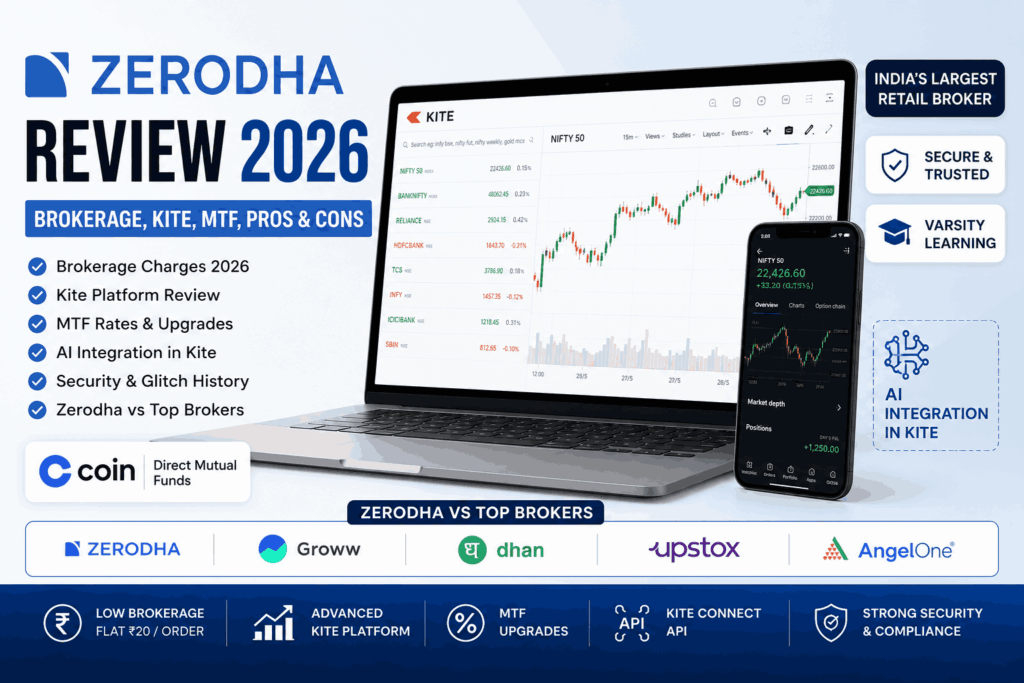
If you have spent any time investing in Indian markets in the last decade, you have crossed paths with Zerodha. Maybe through a friend who switched to Kite, maybe through a Varsity article that taught you what an options strike actually is, or maybe through the simple realisation that Rs. 20 brokerage was a different planet from what your old broker charged. Zerodha did not just enter Indian broking – it broke the cost barrier that kept retail investors out of equity for a generation.
That was 2010. In 2026, Zerodha has 78.9 lakh active clients on the NSE, the largest debt-free discount broking business in India, and a quietly expanding product ecosystem that now includes Kite, Coin, Console, Varsity, the Kite Connect API and – newest of all – Kite MCP, the first AI-integration layer shipped by any Indian broker.
This Zerodha review is a hands-on, independent look at the platform for May 2026. We cover the actual brokerage and charges (no hidden surprises), the Kite platform across web and mobile, the recent MTF upgrades, the third-party tool ecosystem, security and glitch history, and where Zerodha genuinely fits – and does not fit – for different investor profiles. If you are weighing whether to open a Zerodha account, switch from another broker, or keep the one you already have, this is the practical guide.
Zerodha is not the cheapest broker on every line item. It is not perfect on uptime. But for combined product depth, reliability under stress, education content, and ecosystem maturity, it remains the benchmark Indian discount broking is measured against in 2026.
Who is Zerodha, and why does it matter?
Zerodha was founded in August 2010 in Bengaluru by brothers Nithin Kamath and Nikhil Kamath. The name combines “Zero” with “Rodha” (Sanskrit for barrier) – their stated mission was to remove the cost barrier that kept retail traders away from equity markets. Until then, even “discount” brokers in India charged percentage-based brokerage, often Rs. 100-200 per trade.
Zerodha launched with a flat Rs. 20 per trade ceiling and free equity delivery, a structure radical enough that within a few years every discount broker in India had to match it or die. By 2024, Zerodha briefly held the #1 position by active client count before being overtaken by Groww. As of FY 2025-26, Zerodha sits at roughly 78.9 lakh active clients – second by count but generally regarded as the gold standard for trading reliability and depth of tools.
Three structural reasons Zerodha is unusual
- Debt-free, profitable, no PE money. Zerodha has been consistently profitable since around 2014 and has explicitly committed to staying private and never raising venture capital. This is rare. It means there is no investor pressure to monetise users aggressively, sell their data, or push them into adjacent financial products.
- Does not pool client securities or do prop trading. Zerodha keeps each client’s securities in their own demat account and does not engage in proprietary trading with client funds. This is the cleanest structure under SEBI rules and minimises certain types of broker risk.
- Low complaint-to-client ratio. On NSE’s official complaint data, Zerodha consistently shows one of the lowest complaint-to-active-client ratios among the major brokers – even though absolute complaint numbers are higher because of the sheer client base size.
| Attribute | Zerodha (May 2026) |
|---|---|
| Founded | August 2010 |
| Founders | Nithin Kamath, Nikhil Kamath |
| Headquarters | Bengaluru, Karnataka |
| SEBI Registration | INZ000031633 |
| Active clients (NSE) | ~78.9 lakh (FY 2025-26) |
| Cumulative client base | 1.5+ crore registered users |
| Broker type | Discount broker, DIY-first |
| Exchanges | NSE, BSE, MCX, NCDEX |
| Depository | CDSL |
| Ownership | Privately held, debt-free, profitable |
| Account opening fee | Free (Rs. 200 for some account types) |
| Demat AMC | Rs. 300 per year (billed quarterly) |
| Brokerage | Free delivery; Rs. 20 or 0.03% (lower) on F&O, intraday, currency, commodity |
| Mutual funds | Direct plans via Coin platform – zero commission |
Zerodha brokerage charges 2026
Zerodha’s brokerage structure has stayed largely consistent since launch – flat fees with the same ceiling across all segments. The detailed table below reflects the official rates published on zerodha.com as of May 2026.
| Segment | Zerodha Brokerage (2026) |
|---|---|
| Equity Delivery | Rs. 0 – completely free |
| Equity Intraday | Lower of Rs. 20 or 0.03% per executed order |
| Equity Futures | Lower of Rs. 20 or 0.03% per executed order |
| Equity Options | Flat Rs. 20 per executed order |
| Currency Futures | Lower of Rs. 20 or 0.03% per executed order |
| Currency Options | Flat Rs. 20 per executed order |
| Commodity (MCX) | Lower of Rs. 20 or 0.03% per executed order |
| Mutual Funds (Coin) | Rs. 0 – direct plans only, no commission |
| IPO Application | Rs. 0 – free |
| Bonds (via Coin / GoldenPi) | Rs. 0 brokerage on bonds and SGBs |
There is no minimum brokerage on Zerodha. Tiny intraday trades attract 0.03% of trade value (which can be less than Rs. 20 on small tickets). Larger trades cap at Rs. 20. Equity delivery is genuinely zero.
Account opening, AMC and the ‘hidden charges’ question
“Hidden charges” is a phrase that often gets thrown around in broker reviews. With Zerodha, there are no genuinely hidden costs – everything is published on zerodha.com/charges and applied transparently. But there are a few charges beyond the headline brokerage that catch new users off-guard. Here is the full picture:
| Charge | Amount (May 2026) |
|---|---|
| Account opening (online) | Free |
| Account opening (offline / NRI) | Rs. 200-Rs. 500 |
| Demat AMC (Indian residents) | Rs. 300 per year (Rs. 75 + 18% GST quarterly) |
| Demat AMC (NRI) | Rs. 500 per year |
| Trading AMC | Rs. 0 – no separate trading AMC |
| DP charges (per scrip sold) | Rs. 13.50 + 18% GST |
| Call & Trade | Rs. 50 per executed order |
| Auto square-off (intraday) | Rs. 50 per order |
| Pledge / Unpledge | Rs. 30 per scrip |
| Physical contract note | Rs. 25 per script (most users get e-contract notes for free) |
| Payment gateway charges | Rs. 9 per fund transfer (UPI is free) |
| Kite Connect API access | Rs. 2,000 per month (since February 2025) |
Three line items worth flagging specifically:
- Annual demat AMC of Rs. 300. This is split into Rs. 75 + GST quarterly debits. Groww, Dhan and m.Stock all offer zero AMC, so this is one of the few areas where Zerodha is genuinely more expensive than its discount competitors. Over 10 years, that is Rs. 3,000+ versus Rs. 0 at zero-AMC brokers.
- DP charges of Rs. 13.50 + GST per scrip sold. Applies every time you sell a stock from your demat account, regardless of trade size. If you sell 5 different stocks in a day, that is roughly Rs. 80 in DP charges alone. Batch your sells to reduce this.
- Kite Connect API at Rs. 2,000 per month. Since February 2025, the algo trading API requires this subscription. The historical market data API has a separate fee. If you do not write code or run algo strategies, this does not apply to you – but it is worth knowing about if you plan to build automation.
The Zerodha platform ecosystem – Kite and beyond
This is where Zerodha differentiates most clearly from its competitors. Most discount brokers offer a trading app and call it a day. Zerodha has built or partnered with an entire ecosystem of products that integrate into the same login and the same demat account.
| Platform | What It Does |
|---|---|
| Kite (web & mobile) | Flagship trading platform for stocks, F&O, currency and commodities across NSE, BSE and MCX. Available on web (kite.zerodha.com), Android and iOS apps. |
| Coin | Direct mutual fund investing platform – zero commission, direct plans only. Mutual fund units held in demat form, integrated with Console. |
| Console | Reporting and analytics dashboard. Capital gains statements, P&L reports, fund usage, equity dashboard, fee invoices. |
| Varsity | India’s largest free trader education library – over 100 modules covering technical analysis, fundamentals, options strategies, taxation. |
| Sentinel | Cloud-based price alert system – set price-triggered notifications on 80,000+ instruments without needing to keep your device on. |
| Kite Connect API | Algo trading API for developers. Rs. 2,000/month subscription (since Feb 2025). Used by thousands of independent algo trading systems. |
| Kite MCP (new in 2025) | AI integration – lets ChatGPT, Claude and Gemini interact with your account using Model Context Protocol. First Indian broker to ship this. |
| Smallcase, Streak, Sensibull (third-party) | Integrated thematic investing (Smallcase), no-code algo strategies (Streak), and options trading platforms (Sensibull) – all connect natively to Kite. |
What’s new on Kite in 2025-2026
Zerodha has historically been criticised for moving slowly on product, but the last 12 months have seen a noticeable acceleration. Here are the most consequential updates:
- Kite MCP for AI assistants. Connect your Zerodha account directly to Claude, ChatGPT or Gemini via Model Context Protocol. The AI can read your portfolio, suggest analysis, even place GTT orders with your permission. First Indian broker to ship this.
- TradingView charts on Kite Web. TradingView’s advanced charting now natively integrated into Kite Web, with trade-from-chart workflow.
- MarketWatch redesign. Up to 25 watchlists with 250 instruments each – useful for traders tracking many segments or themes.
- Improved Nudges. Risk-warning nudges (high-PE warnings, volatility alerts) now appear as in-window icons instead of pop-up interrupts – faster order placement while preserving the safety signal.
- In-app holdings breakdown. Tap any stock in your portfolio to see purchase-date, P&L, holding period for each tranche – useful for FIFO tax calculations.
- Order slicing for large orders. Big orders are automatically sliced to reduce market impact and improve execution price.
Zerodha MTF 2026: significantly upgraded
Margin Trading Facility (MTF) is one of the segments where Zerodha has made the biggest gains in the last year. The product was launched in 2024 and has been progressively expanded through 2025-2026. Here is what it looks like now:
| MTF Feature | Zerodha (May 2026) |
|---|---|
| Eligible stocks | 1,300+ scrips |
| Maximum leverage | Up to 5x |
| Per-stock limit | Up to Rs. 6 crore |
| Per-account limit | Up to Rs. 30 crore |
| Interest rate | ~10.5% per annum on outstanding |
| MTF to Delivery conversion | Available – one-tap conversion without exit |
| GTT orders for MTF | Available |
| AMO orders for MTF | Available |
| Holding period | Unlimited |
The MTF interest rate of ~10.5% is competitive but not class-leading – m.Stock’s tiered 6.99-14.99% rates beat Zerodha at higher borrowing volumes. However, the integration with the rest of the Zerodha ecosystem (GTT, AMO, Console reporting, easy conversion to delivery) is materially better than at most competitors.
Security, regulation and trustworthiness
Zerodha operates as a SEBI-registered stockbroker (INZ000031633), a depository participant with CDSL (DP ID 12081600), and an AMFI-registered mutual fund distributor. The protection framework is standard for any SEBI-regulated broker:
- Securities in CDSL under your PAN. Your shares are never held by Zerodha. They sit in your demat account at CDSL, under your name. Even in a worst-case scenario, your shares would remain accessible.
- Client funds segregation, daily settlement. Client funds sit in separate bank accounts under SEBI rules, with daily true-ups.
- Investor Protection Fund coverage. NSE and BSE both maintain IPF schemes covering eligible claims up to prescribed limits in case of broker default.
What sets Zerodha apart on safety
- Zero debt. Zerodha is a debt-free company – no working-capital loans, no leverage on its own balance sheet. This is unusual for a brokerage.
- No proprietary trading with client funds. Zerodha does not trade for its own account using client money. This is a stronger separation than SEBI requires.
- No pooled securities accounts. Each client’s securities sit in their own demat account, not a broker-pooled omnibus account.
Glitches and outages – the honest record
Zerodha is not glitch-free. NSE’s published technical-issue data shows Zerodha at 4 reported technical glitches in FY 2025-26, down from 8 in FY 2023-24. Compared to its scale (~80 lakh active clients), this works out to a very low glitch-per-client rate, but during outages the inconvenience for individual traders is real.
If you trade during a Zerodha outage and lose money, the documented arbitration record shows that traders generally need solid evidence – same-day support tickets, screenshots, screen recordings, time-stamped error messages – to succeed in claims. The platform is reliable, but redundancy (a secondary broker for emergencies) is a sensible precaution for active F&O traders.
Zerodha’s reliability is best-in-class for Indian discount brokers, not flawless. An active trader should accept that occasional outages happen and have a fallback plan for the trade that absolutely has to go through.
Zerodha vs Groww, Dhan, Upstox, Angel One and m.Stock
Here is how Zerodha stacks up against the most-considered alternatives in 2026:
| Broker | Delivery | F&O | AMC | Direct MF | Best For |
|---|---|---|---|---|---|
| Zerodha | Free | Rs. 20/order | Rs. 300/yr | Yes (Coin) | Active traders + DIY investors |
| Groww | Free / 0.1% | Rs. 20/order | Rs. 0 | Yes | First-time investors |
| Upstox | Free | Rs. 20/order | Rs. 150-300 | Yes | Mobile-first traders |
| Dhan | Free | Rs. 20/order | Rs. 0 | Yes | Active F&O / options traders |
| Angel One | Free | Rs. 20/order | Rs. 0 (Y1) | Both | Research-led investors |
| m.Stock | Free | Rs. 5/order (Rs. 999 plan) | Rs. 0 (extra Rs. 999) | Yes | High-volume MTF traders |
Zerodha vs Groww
Groww has more active clients (largest in India at ~1.21 crore), simpler UX for beginners, and zero AMC. Zerodha has deeper tools, more reliable execution during volatility, the Kite Connect API, Varsity education, and direct mutual funds via Coin. For first-time investors, Groww is friendlier. For traders who plan to graduate beyond basic delivery investing, Zerodha is the longer-term platform.
Zerodha vs Dhan
Dhan has the best TradingView integration in Indian broking and arguably the best options trading interface. Zerodha has more reliable execution under stress, deeper tools beyond F&O (Varsity, Console, MCP, MTF integration), and a much larger third-party ecosystem (Sensibull, Streak, Smallcase). For pure options-day-trader use, Dhan is competitive. For everything else, Zerodha is broader.
Zerodha vs Upstox
Upstox has a slightly faster mobile-first feel and aggressive marketing. Zerodha has a more mature platform, deeper education content, and a stronger third-party tool ecosystem. For most use cases, Zerodha is the more complete choice – though Upstox is a credible alternative for traders who prefer its UI.
Zerodha vs Angel One
Angel One offers research recommendations (ARQ Prime) bundled with discount-broker pricing – useful if you want guidance alongside execution. Zerodha is research-neutral – it does not give buy/sell tips. For DIY traders, Zerodha’s cleaner ecosystem wins. For investors who want research, Angel One has the edge.
Zerodha vs m.Stock
m.Stock’s Rs. 999 one-time plan gives Rs. 5-per-order F&O and 6.99-14.99% MTF rates – both better than Zerodha for very high-volume traders. Zerodha counters with platform reliability, the Kite Connect ecosystem, Varsity, and the absence of any upfront commitment. For ultra-active traders willing to pay upfront, m.Stock saves money. For everyone else, Zerodha is structurally smoother.
Zerodha pros and cons – honest take
Pros
- Genuinely free equity delivery – no asterisks
- Flat Rs. 20 cap on intraday, F&O, currency and commodity – industry standard, transparent
- Kite platform is consistently rated the most reliable trading app in India
- Coin gives you direct-plan mutual funds at zero commission
- Varsity is unmatched as a free trader-education resource
- Kite Connect API is the most-used algo trading API in India
- MTF coverage expanded to 1,300+ stocks with up to 5x leverage and unlimited holding
- First Indian broker to integrate AI via Kite MCP
- Debt-free, profitable, and committed to staying private – structurally stable
- Does not engage in proprietary trading with client funds
- Strong third-party integration (Sensibull, Streak, Smallcase, Tijori)
Cons
- Rs. 300 demat AMC – higher than Groww, Dhan and m.Stock’s zero-AMC offerings
- Mutual funds live in a separate app (Coin) rather than alongside trading
- Customer support response time during peak market hours can be slow
- No research reports or stock recommendations – DIY-only model
- Kite Connect API now Rs. 2,000/month (since Feb 2025) – higher cost for casual algo users
- Call & Trade at Rs. 50 per order is on the higher side
- Occasional platform outages during extreme volatility, though rare
- No NRI account at par with PIS-enabled brokers – separate process
- MTF interest at ~10.5% is competitive but not class-leading (m.Stock at 6.99% beats this)
- Aggressive RMS square-offs near margin shortfall can frustrate traders
Latest 2026 updates and what’s changed at Zerodha
Here is a quick summary of the meaningful updates rolled out in the last year that affect investor experience:
- Kite MCP (Model Context Protocol) launched (mid-2025). First Indian broker to enable AI assistants like Claude, ChatGPT and Gemini to read account data and assist with analysis.
- MTF major expansion. Eligible stocks doubled to 1,300+; per-stock limit raised to Rs. 6 crore; MTF-to-delivery conversion enabled; GTT and AMO orders now supported on MTF.
- Updated nudge UX. Risk warnings now appear as in-window icons instead of full pop-ups, speeding up order entry while keeping the safety signal.
- TradingView charts in Kite Web. Native TradingView integration with trade-from-chart workflow.
- Stock pages powered by Tijori. Detailed company research and fundamentals available within Kite, no separate app needed.
- Kite Connect API pricing change. API access now Rs. 2,000/month since February 2025 (replacing the older free-with-paid-historical-data model).
- Higher STT on F&O (April 2026). Futures STT raised to 0.05% on sell, options STT to 0.15% on sell premium. This is a government tax, applies at every broker – not Zerodha-specific.
Frequently Asked Questions
Q1. Is Zerodha review consensus positive in 2026?
Yes. Across independent reviewers and comparison sites in 2026, Zerodha consistently ranks at or near the top among Indian discount brokers, particularly for platform reliability, ecosystem depth and education content. The most common reservations relate to Rs. 300 AMC (higher than zero-AMC competitors) and customer-support response times during peak market hours. Overall ratings typically land between 4.3 and 4.6 out of 5.
Q2. What is Zerodha’s brokerage on equity delivery and F&O in 2026?
Equity delivery is completely free – Rs. 0 brokerage. For intraday, F&O, currency and commodity trades, Zerodha charges the lower of Rs. 20 or 0.03% per executed order. Options are flat Rs. 20 per order. Mutual funds via Coin are zero commission. There is no minimum brokerage.
Q3. Is Zerodha safe to use?
Yes. Zerodha is SEBI-registered (INZ000031633), CDSL depository participant, debt-free, profitable, and does not engage in proprietary trading with client funds or pool client securities. Your shares are held in your own demat account under your PAN. Investor Protection Fund coverage applies under SEBI’s standard framework. Zerodha’s complaint-to-client ratio is among the lowest in the industry.
Q4. What is the Zerodha annual maintenance charge (AMC)?
Zerodha charges Rs. 300 per year as demat account AMC, billed quarterly (Rs. 75 + 18% GST per quarter). NRI accounts cost Rs. 500 per year. There is no separate trading AMC. Account opening is free for online residents.
Q5. How does Zerodha compare with Groww?
Groww has more active clients (largest in India), simpler UX for beginners, and zero AMC. Zerodha has deeper tools, more reliable execution under stress, the Kite Connect API, Varsity education, and direct mutual funds via Coin. For first-time investors, Groww is friendlier. For traders who plan to graduate beyond basic delivery investing – especially into F&O or algo trading – Zerodha is the more complete long-term platform.
Q6. Does Zerodha offer mutual funds?
Yes, through its sister app Coin. All mutual funds on Coin are direct plans only – zero commission, no embedded distributor fees. Mutual fund units are held in your demat account. Coin works seamlessly with the rest of the Zerodha ecosystem, including Console for consolidated reporting and capital gains statements.
Q7. What is Kite MCP and is it safe to use?
Kite MCP (Model Context Protocol) is Zerodha’s AI integration launched in 2025, allowing AI assistants like Claude, ChatGPT and Gemini to read your account data and assist with analysis. It uses secure OAuth-based authentication and your AI assistant only gets the permissions you explicitly grant – read-only by default, with explicit confirmation needed for any order placement. It is the first such integration shipped by any Indian broker.
Q8. Does Zerodha have hidden charges?
Zerodha does not have hidden charges – all fees are published on zerodha.com/charges. The most common surprises for new users are the Rs. 13.50 + GST DP charge per scrip sold (delivery only), the Rs. 50 Call & Trade fee, and the Rs. 2,000/month Kite Connect API subscription if you want algo trading. Statutory charges (STT, GST, exchange transaction, stamp duty) apply uniformly across all Indian brokers.
Q9. Does Zerodha have a glitch problem?
Zerodha has had platform outages, but the rate has improved significantly. NSE-published data shows Zerodha at 4 technical issues in FY 2025-26, down from 8 in FY 2023-24. Compared to its 78.9 lakh active clients, the rate is among the lowest in the industry. That said, no broker is glitch-free. Serious traders should maintain a secondary broker as backup for critical trades.
Q10. How long does Zerodha account opening take?
The application is fully online, takes 10-15 minutes of active effort, and accounts are typically activated within 24-48 hours after SEBI and exchange verification. You need PAN, an Aadhaar-linked mobile number, a bank account, and (for F&O) income proof. Account opening is free for Indian residents – there is no upfront cost.
Final verdict: should you choose Zerodha in 2026?
Yes – for most active equity traders, DIY long-term investors, and anyone serious about building a multi-year trading or investing journey, Zerodha remains the most complete brokerage in India in 2026. Other brokers beat it on specific line items – Groww on AMC, Dhan on options charting, m.Stock on F&O brokerage at high volume – but no other broker matches the total package.
Three takeaways from this Zerodha review:
- Pay the Rs. 300 AMC, get the ecosystem. If you save even one mistake a year because Varsity taught you something useful, the Rs. 300 has paid back many times over. The ecosystem is not just nice-to-have; it actively makes you a better, lower-cost investor over years.
- Use the right tool for the right job. Kite for trading. Coin for mutual funds. Varsity for education. Console for tracking. Kite Connect for algo. Smallcase for thematic investing. The strength of Zerodha is that all of these are integrated into one demat account – use them deliberately.
- Have a backup for high-stakes days. Zerodha is the most reliable Indian discount broker, but no broker is glitch-free. For days that matter – Budget day, RBI policy day, expiry day – having a secondary account at Dhan or m.Stock is sensible insurance, not paranoia.
Zerodha is not for everyone. If you need a relationship manager, want stock tips, or are buying mutual funds in regular plans, you are paying for things Zerodha does not provide. But if you want to learn, trade, and invest independently with the best DIY infrastructure in India, Zerodha is still the answer.
The right broker is not the cheapest on any single line item. It is the one that lowers your cost of being wrong over years – through education, reliability, and clean execution. By that measure, Zerodha continues to lead in 2026.
