
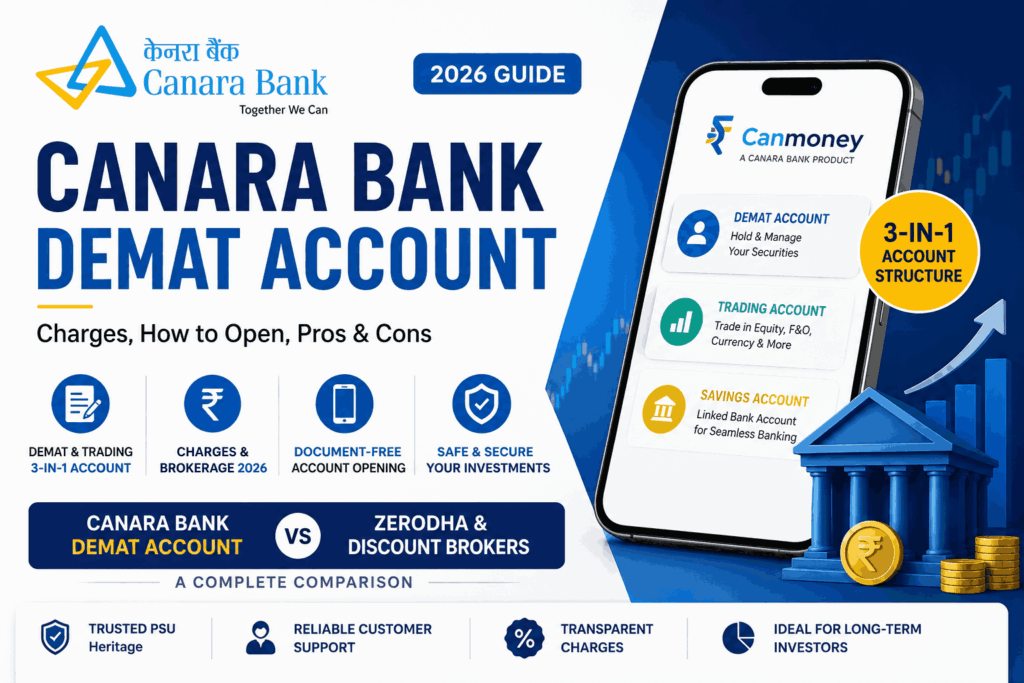
If you bank with Canara Bank and have been thinking about opening a demat account to start investing, you have probably wondered whether it makes sense to keep everything inside one institution. Canara Bank itself does not directly run a stock-broking business – that is handled by its wholly-owned subsidiary, Canara Bank Securities Ltd. (also branded as Canmoney) – but the two are tightly integrated through a 3-in-1 account structure that links your savings, trading and demat accounts under one login.
The pitch is convenience. The trade-off is cost. Canara Bank’s demat charges are competitive on the AMC side – cheaper than ICICI Direct or HDFC Securities – but its brokerage rates are dramatically higher than what discount brokers like Zerodha, Groww or Dhan charge. Whether the trade-off is worth it depends entirely on how much you trade, how much you value the bank-grade integration, and whether you would actually use the human support that comes with a PSU bank broker.
This guide unpacks the Canara Bank demat account end-to-end – the structure, charges, opening process (including the new document-free Omni Channel route), trading platforms, security framework, and an honest comparison against the discount brokers most retail investors actually use in 2026. By the end, you should know whether this is the right account for your situation.
Canara Bank’s strongest argument is the 3-in-1 integration for existing customers. Its weakest is the brokerage cost on active trading. If you mostly buy stocks and hold them long-term, the cost gap with discount brokers is meaningful. If you barely trade, the convenience may still be worth it.
What is a Canara Bank demat account? The basics first
A demat account is essentially an electronic locker that holds your investments – stocks, bonds, mutual fund units, ETFs, government securities – in digital form rather than as physical paper certificates. Since 2019, holding equity in physical certificate form is no longer allowed for transfers; everything has to sit in a demat account at either of India’s two depositories – CDSL or NSDL.
The Canara Bank demat account is held by Canara Bank Securities Ltd. (CBSL), which is a SEBI-registered depository participant (DP). CBSL has membership with both CDSL and NSDL, so depending on which depository your shares are issued in, your holdings sit there under your PAN. The trading account, separately, is what allows you to actually buy and sell – the demat account is the storage layer. The savings account closes the loop by handling the money flow.
The 3-in-1 structure explained
Most Canara Bank demat customers open the 3-in-1 account, which is the combination of three linked accounts:
- Canara Bank savings account: Your primary bank account where money sits and earns interest.
- Canmoney trading account: Held by CBSL, this is what lets you place buy and sell orders on NSE, BSE and MCX (for commodities, via tie-ups).
- Canara Bank demat account: Held at CDSL or NSDL through CBSL. This is where your purchased shares actually live.
The advantage of the 3-in-1 structure is one-tap money movement. When you buy stocks, money debits straight from your savings; when you sell, proceeds credit back. You do not need to manually transfer funds from your bank to a third-party broker and wait for clearance. For investors who value frictionless settlement, this is a real workflow improvement.
| Attribute | Canara Bank Demat (May 2026) |
|---|---|
| Parent bank | Canara Bank (founded 1906) |
| Broking arm | Canara Bank Securities Ltd. (CBSL), also branded as Canmoney |
| Headquarters | Bengaluru, Karnataka |
| Public sector / Private | Public Sector Undertaking (PSU) |
| SEBI Registration (CBSL) | INZ000005031 |
| Depository participants | Both CDSL and NSDL |
| Account structure | 3-in-1 (Savings + Trading + Demat) |
| Account opening fee | Free (NIL) |
| Demat AMC | Rs. 500 per year (subsidised for select customer segments) |
| Trading AMC | Built into demat AMC, no separate trading fee |
| NRI accounts | Yes – both Repatriable (NRE-linked) and Non-Repatriable (NRO-linked) |
| Mobile app | Canmoney mobile app (Android & iOS) |
| Web platform | Canmoney web trading terminal |
Canara Bank demat account charges in 2026
Demat-related charges fall into two categories – one-time/annual charges (account opening, AMC, DP charges) and per-trade brokerage. Let us look at each in turn.
Brokerage charges (Canmoney rates)
| Segment | Canmoney Brokerage Rate |
|---|---|
| Equity Delivery | 0.35% of trade value (significantly higher than discount brokers) |
| Equity Intraday | 0.04% to 0.05% of trade value (both legs) |
| Equity Futures | 0.04% to 0.05% of trade value |
| Equity Options | Rs. 100 per lot (or 1% of premium, whichever higher) |
| Currency Futures | Rs. 25 per contract |
| Currency Options | Rs. 25 per lot |
| Commodity (via tie-ups) | Percentage-based, varies |
| Mutual Funds (Regular plans) | Distributor commission embedded in NAV |
| IPO Application | Free via ASBA |
Notice the structure: equity delivery at 0.35% is substantially higher than the Rs. 0 most discount brokers now charge. On a Rs. 1 lakh delivery trade, this is Rs. 350 in brokerage alone – versus Rs. 0 at Zerodha or Groww. Over a long-term portfolio with periodic buying, this gap compounds materially.
Account-level and ancillary charges
| Charge | Amount (May 2026) |
|---|---|
| Account opening | Free (NIL) |
| Demat AMC (resident) | Rs. 500 per year |
| Demat AMC (NRI) | Rs. 1,000 per year |
| Demat AMC (BSDA – basic services) | Free (if portfolio under Rs. 50,000); Rs. 100 (Rs. 50,000-2 lakh) |
| DP charges (per scrip sold) | Rs. 17.50 + 18% GST per debit transaction |
| Pledge / Unpledge | Rs. 25-50 per scrip |
| Dematerialisation (physical to demat) | Rs. 25 per certificate + Rs. 50 courier |
| Rematerialisation (demat to physical) | Rs. 25 per 100 securities or 0.04% (whichever higher) |
| Physical contract note | Rs. 25 each (electronic notes are free) |
| Account closure | Free |
| Account modification | Free (online); nominal for branch-driven changes |
| Cheque bounce | Rs. 350-500 |
Statutory charges – same at every Indian broker
Beyond brokerage and demat fees, every Indian trade also attracts statutory charges that no broker can waive – including Canara Bank:
- Securities Transaction Tax (STT): 0.1% on delivery (both legs), 0.025% on intraday (sell only), updated F&O rates effective April 2026
- Exchange Transaction Charges: roughly 0.00297% on equity, varies on F&O
- SEBI Turnover Fee: 0.0001% of turnover
- Stamp Duty: 0.015% delivery, 0.003% intraday, on buy side only
- GST: 18% on brokerage, exchange charges, SEBI fee and DP charges
How Canara Bank demat charges compare in rupee terms
Tables of percentage rates are abstract. Here is what the cost actually looks like on real-world trades, with Canara Bank set against a typical discount broker setup like Zerodha or Groww:
| Trade Scenario | Canara Bank Cost | Zerodha / Groww (Discount) Cost |
|---|---|---|
| Rs. 1 lakh delivery buy + sell | ~Rs. 700 brokerage + charges | ~Rs. 25-50 (free delivery + DP + statutory) |
| Rs. 5 lakh delivery buy + sell | ~Rs. 3,500 brokerage + charges | ~Rs. 50 (free delivery + DP + statutory) |
| Rs. 1 lakh intraday round trip | ~Rs. 80-100 brokerage | Rs. 40 brokerage |
| 1 lot Nifty options round trip | Rs. 200 (Rs. 100 per leg) | Rs. 40 (Rs. 20 per leg) |
| 50 F&O orders / month | Rs. 10,000+ per month | Rs. 1,000 per month |
| 10-year demat AMC cost | Rs. 5,000+ in AMC | Rs. 0-3,000 depending on broker |
Two patterns are worth highlighting:
- On equity delivery, the cost gap is large and grows with trade size. A Rs. 5 lakh delivery round-trip costs Rs. 3,500 in Canara Bank brokerage versus essentially zero at Zerodha. For long-term equity investors who occasionally rebalance large positions, this gap is the single biggest reason to consider a discount broker over a bank-based one.
- On options and F&O, the percentage-vs-flat-fee difference is dramatic. Canara Bank’s Rs. 100 per lot on options versus Zerodha’s flat Rs. 20 per order means an active options trader pays 5x more in brokerage. Over a year of even modest F&O activity, this becomes lakhs of rupees.
How to open a Canara Bank demat account in 2026
Canara Bank has two routes to open a demat account, and the choice depends on whether you already bank with them and whether you want the full 3-in-1 setup or a standalone demat.
Route 1: Document-free Omni Channel (online, fastest)
Launched as a digital simplification initiative, the Omni Channel route lets you open a standalone demat account without uploading documents, using just your existing Canara Bank netbanking or mobile banking credentials. The system pulls your KYC data from the linked bank account.
- Visit candi.canarabank.in/omnichannel/ on a browser or mobile.
- Log in with your Canara Bank internet banking credentials.
- The system auto-fills your name, PAN, address and bank-account-linked details.
- Confirm and submit. No uploads needed.
- Account is typically activated within 24-48 hours.
Route 2: Standard digital application via Canmoney
If you do not yet have a Canara Bank savings account or want the full 3-in-1 setup, the standard route goes through Canmoney’s onboarding portal.
- Visit canmoney.in and click “Open Account.”
- Enter your basic details – name, mobile number, email, PAN.
- Complete Aadhaar-based e-KYC with OTP verification.
- Upload supporting documents (PAN, signature, cancelled cheque, bank statement, income proof if applying for F&O).
- Complete the in-person verification (IPV) – a brief video call where you confirm identity by reading a code aloud.
- E-sign the application using Aadhaar OTP.
- Account is activated in 3-5 working days after exchange and SEBI verification.
Documents needed
- PAN card (JPEG or PNG, up to 2 MB)
- Aadhaar card linked to your mobile number
- Cancelled cheque from your Canara Bank savings account
- Latest bank statement (PDF, up to 2 MB)
- Signature on white paper (JPEG/PNG, up to 96 KB)
- Income proof – salary slip / ITR / 6-month bank statement (only required for F&O segment activation)
The Omni Channel route is genuinely impressive – if you already bank with Canara Bank, you can have a demat account in 24-48 hours without uploading a single document. For first-time investors looking for the lowest-friction onboarding, it is a real advantage over standalone discount brokers.
Trading platforms and mobile app
The Canara Bank demat account operates through Canmoney’s trading platforms. There are essentially two ways to trade:
Canmoney Web Trading Terminal
The web-based trading terminal is accessible at canmoney.in/login and works across desktop browsers and mobile. It supports the standard order types (market, limit, stop-loss), basic charting with technical indicators, watchlists, and segment-wise navigation across equity, F&O, currency and IPO sections. The interface is functional but feels noticeably older than discount-broker apps like Kite, Groww or Dhan.
Canmoney Mobile App
Available on both Android and iOS, the Canmoney app brings the same trading capabilities to mobile. The app handles order placement, portfolio tracking, fund transfers (through the linked Canara Bank savings account) and IPO applications. App-store ratings sit around 3.4-3.8 stars – middling by industry standards. Performance during peak market hours can be inconsistent compared to Zerodha Kite or Groww.
Charting and tools
Charting is functional – moving averages, RSI, MACD, Bollinger Bands and the common indicator suite are available, but the experience does not approach TradingView-grade integrations seen on Dhan or modern Kite. For traders who rely heavily on advanced charting workflows, this is a significant limitation.
Order execution speed
Execution speed is adequate for delivery investing and casual trading. For active intraday or F&O traders, the platform’s latency is noticeably higher than discount-broker offerings. This is partly because the platform was not architected for high-frequency retail trading the way Kite or Dhan were.
Security, regulation and trustworthiness
This is where the Canara Bank demat account holds its strongest argument. Canara Bank is a Public Sector Undertaking (PSU) – majority-owned by the Government of India – and has been operating since 1906. It is one of the most institutionally stable financial entities in India. The protections that apply:
- PSU bank backing. The brokerage subsidiary (CBSL) is wholly-owned by Canara Bank. For investors who genuinely worry about broker continuity risk, a PSU-bank-owned broker is structurally safer than a venture-funded startup.
- SEBI regulation. CBSL is a SEBI-registered stockbroker (INZ000005031), with depository participant memberships at both CDSL and NSDL. The full SEBI compliance framework applies – client funds segregation, daily settlement true-ups, Investor Protection Fund coverage.
- Holdings in your own name. Your shares are held in your demat account at CDSL or NSDL under your PAN – not in any pooled account. Even in a theoretical broker insolvency scenario, your shares stay safe and can be transferred to another DP.
- Two-factor authentication. Every login attempt requires both password and OTP. Biometric login is supported on the mobile app.
On safety and regulatory standing, the Canara Bank demat account is among the most institutionally trustworthy options in Indian broking. The question is not safety; the question is whether the cost premium is worth the institutional backing.
Canara Bank demat vs other brokers: how it stacks up
Here is how Canara Bank’s demat and brokerage structure compares against the other major options Indian investors actually choose in 2026 – both bank-based 3-in-1 brokers and discount brokers.
| Broker | Account Type | Delivery Brokerage | F&O Brokerage | Demat AMC |
|---|---|---|---|---|
| Canara Bank (Canmoney) | 3-in-1 (PSU bank) | 0.35% | 0.04-0.05% or Rs. 100/lot | Rs. 500/yr |
| ICICI Direct | 3-in-1 (Private bank) | 0.275-0.55% (slab) | Slab-based | Rs. 700/yr |
| HDFC Securities | 3-in-1 (Private bank) | 0.32-0.50% (slab) | Slab-based | Rs. 750/yr |
| SBI Securities | 3-in-1 (PSU bank) | 0.50% / Rs. 20 plans | Rs. 75/lot or Rs. 20 | Rs. 350/yr |
| Zerodha | Discount broker | Free | Rs. 20/order | Rs. 300/yr |
| Groww | Discount broker | Free / Rs. 20 | Rs. 20/order | Rs. 0 lifetime |
| Dhan | Discount broker | Free | Rs. 20/order | Rs. 0 |
Two observations from this table:
- Among bank-based brokers, Canara is competitive. Versus ICICI Direct (Rs. 700 AMC, 0.275-0.55% delivery), HDFC Securities (Rs. 750 AMC, 0.32-0.50% delivery) and SBI Securities (Rs. 350 AMC, 0.50% delivery), Canara Bank’s Rs. 500 AMC and 0.35% delivery brokerage is solidly mid-pack. If you have decided you want a PSU bank broker for the institutional backing, Canara is reasonably priced.
- Against discount brokers, the cost gap is enormous. Zerodha and Dhan charge zero on delivery brokerage, where Canara charges 0.35%. On a Rs. 1 lakh delivery trade, that is Rs. 350 versus Rs. 0. The decision is really between two camps: bank-based brokers (where the convenience is paid for with brokerage) and discount brokers (where you trade integration for radical cost savings).
Pros and cons of the Canara Bank demat account
Pros
- 3-in-1 integration – seamless money flow between savings, trading and demat
- PSU-bank backing – among the safest broker structures in India
- Free account opening with no upfront cost
- Document-free Omni Channel opening for existing Canara Bank customers – genuinely fast
- Both CDSL and NSDL membership – you choose your depository
- Demat AMC of Rs. 500/year is reasonable for a bank-based broker
- Branch support across India – over 9,000+ Canara Bank branches
- NRI accounts supported (both Repatriable and Non-Repatriable)
- Useful for investors who want one institution handling all financial relationships
Cons
- Brokerage on equity delivery (0.35%) is dramatically higher than discount brokers (free)
- Options brokerage at Rs. 100 per lot is 5x higher than the Rs. 20 industry standard
- Trading platform feels dated compared with Kite, Groww or Dhan
- Mobile app performance can lag during peak market sessions
- Limited algo trading and API support
- Smaller active client base (~10,000 historically) means thinner third-party ecosystem
- No direct mutual funds – only regular plans with embedded commissions
- Charting tools trail what TradingView-integrated platforms offer
- Customer support response times can vary by branch and ticket type
Who should open a Canara Bank demat account – and who should not
This account makes sense for you if you…
- Are already a Canara Bank savings account holder and want seamless integration
- Make occasional equity investments (a few trades per quarter, not active trading)
- Value PSU-bank institutional backing and branch presence
- Prefer human support over self-service digital platforms
- Live in a tier-2 or tier-3 city where Canara Bank’s branch network is your existing relationship
- Want one institution handling savings, demat, mutual funds and insurance together
- Are an NRI looking for a PSU-bank demat account with both repatriable and non-repatriable options
This account is probably not for you if you…
- Trade actively – intraday or F&O – the brokerage cost will compound badly
- Are a long-term equity investor with regular large delivery trades
- Want the cheapest possible cost structure – discount brokers win clearly
- Need direct mutual funds with zero commission (use Zerodha Coin, Groww or Kuvera instead)
- Want a modern, mobile-first trading app
- Need advanced charting, algo trading APIs or third-party tool integrations
- Are starting out and want a low-cost, low-friction first demat account
Latest 2026 updates affecting Canara Bank demat customers
A few changes worth knowing about in 2026:
- Higher STT on F&O (April 2026). Government raised STT on futures (0.02% to 0.05% on sell side) and options (0.10% to 0.15% on sell premium). These are statutory charges – identical at every broker – but worth noting if you trade F&O at Canara Bank.
- Capital gains tax framework. Equity LTCG taxed at 12.5% on gains above Rs. 1.25 lakh per year. STCG at 20%. Holding period for equity LTCG eligibility remains 12 months. Identical across all Indian brokers.
- Continued digitisation of the Omni Channel route. Canara Bank has continued to simplify the document-free opening flow for existing customers, with the standalone demat onboarding now genuinely competitive with discount-broker speeds for first-time openers.
Frequently Asked Questions
Q1. What is the Canara Bank demat account and how does it work?
A Canara Bank demat account is an electronic account held with Canara Bank Securities Ltd. (CBSL), the broking subsidiary of Canara Bank. It stores your investments – stocks, bonds, mutual fund units, ETFs – in dematerialised form at CDSL or NSDL. When you buy shares through the linked Canmoney trading account, money debits from your Canara Bank savings, and the shares credit to your demat. When you sell, the reverse happens.
Q2. What are the Canara Bank demat account opening charges?
Account opening is free (NIL) for both online and branch-based applications. There is no upfront cost to open a Canara Bank demat account, whether you use the document-free Omni Channel route or the standard Canmoney application.
Q3. What is the AMC for a Canara Bank demat account?
The Annual Maintenance Charge for a Canara Bank demat account is Rs. 500 per year for resident customers and Rs. 1,000 per year for NRI accounts. If your portfolio value is under Rs. 50,000, you qualify for the Basic Services Demat Account (BSDA) which is completely free. Between Rs. 50,000 and Rs. 2 lakh, the BSDA fee is Rs. 100 per year.
Q4. What are the Canara Bank brokerage charges?
Equity delivery: 0.35% of trade value. Equity intraday: 0.04-0.05% of trade value (both legs). Equity futures: 0.04-0.05% of trade value. Equity options: Rs. 100 per lot. Currency: Rs. 25 per lot. These rates are significantly higher than discount brokers like Zerodha (free delivery, Rs. 20 F&O) or Groww (Rs. 20 across most segments), making Canara Bank cost-effective only for very low trading volumes.
Q5. How do I open a Canara Bank demat account online?
If you are an existing Canara Bank customer, the fastest route is the Omni Channel at candi.canarabank.in/omnichannel/ – log in with your existing netbanking credentials and the account opens without document uploads in 24-48 hours. If you are new to Canara Bank or want the full 3-in-1 setup, apply through canmoney.in with PAN, Aadhaar, signature, cancelled cheque and bank statement. The full process takes 3-5 working days.
Q6. Is the Canara Bank demat account safe?
Yes. Canara Bank Securities Ltd. is a SEBI-registered stockbroker (INZ000005031) and depository participant with both CDSL and NSDL. Canara Bank itself is a PSU bank majority-owned by the Government of India. Your shares are held in your name at CDSL or NSDL, not by the broker. Client funds are segregated per SEBI norms, and Investor Protection Fund coverage applies. Among Indian brokers, the institutional safety profile is one of the strongest.
Q7. Are there any hidden charges in the Canara Bank demat account?
There are no truly hidden charges – all fees are disclosed on the canarabank.com tariff schedule. The most common surprise for new users is the Rs. 17.50 + GST DP charge per scrip on every delivery sell, the Rs. 25-50 pledge/unpledge fees, and the Rs. 100-per-lot options brokerage. Statutory charges (STT, GST, stamp duty, exchange charges) apply uniformly across all Indian brokers.
Q8. Can NRIs open a Canara Bank demat account?
Yes. Both Repatriable (NRE-linked) and Non-Repatriable (NRO-linked) demat accounts are supported. The Repatriable account allows you to transfer proceeds abroad, while the Non-Repatriable account keeps funds within India. NRI demat AMC is Rs. 1,000 per year. Documentation includes overseas address proof, passport and a PIS (Portfolio Investment Scheme) approval from the linked bank account.
Q9. Can I trade in F&O and commodities with a Canara Bank demat account?
Yes, the Canmoney trading account supports equity F&O, currency derivatives and commodity trading (via tie-ups with MCX-licensed brokers). To activate F&O, you need to submit income proof – typically a salary slip, latest ITR or 6-month bank statement. Activation can take 2-3 working days after document submission.
Q10. How does Canara Bank demat account compare with Zerodha or Groww?
Canara Bank wins on PSU-bank institutional backing, 3-in-1 integration with the savings account, and branch support across India. Zerodha and Groww win decisively on cost – free equity delivery vs Canara Bank’s 0.35%, Rs. 20 F&O vs Rs. 100 per lot, and significantly more modern trading platforms. For long-term investors making large delivery trades, the discount brokers will save you tens of thousands of rupees over a few years. For occasional investors who value bank integration, Canara Bank can be the right pick.
Final verdict: should you open a Canara Bank demat account in 2026?
The Canara Bank demat account is a perfectly reasonable choice for a specific kind of investor – one who already banks with Canara Bank, makes occasional rather than frequent trades, and genuinely values the institutional backing of a 119-year-old PSU bank. For that investor, the 3-in-1 integration is a real workflow advantage, and the Rs. 500 AMC is competitive with other bank-based brokers.
But for most retail investors in 2026 – particularly those who do active trading, F&O, or even regular equity delivery investing – the brokerage gap with discount brokers is too wide to ignore. A Rs. 5 lakh delivery trade at Canara Bank costs roughly Rs. 3,500 in brokerage. The same trade at Zerodha or Groww costs essentially zero. Over a multi-year investing journey, that gap compounds into lakhs of rupees of avoidable cost.
Three takeaways from this Canara Bank demat account review:
- Match the account to your trading frequency. If you place fewer than 10 trades a year and value the 3-in-1 convenience, Canara Bank works fine. If you trade more, the cost case for switching to a discount broker is overwhelming.
- Use the Omni Channel for existing Canara Bank customers. If you decide to open a Canara Bank demat account, the document-free Omni Channel route is genuinely fast. There is no reason to use the longer standard application unless you specifically need the full 3-in-1 setup.
- Treat Canara Bank as the long-term storage layer, not your active trading account. Some investors keep their Canara Bank demat for slow-moving long-term holdings (where the brokerage hit is small and infrequent), while running an active trading account at Zerodha or Dhan separately. This dual-broker setup gets you institutional safety on the long-term portfolio plus low-cost execution on active trades.
There is no single right answer here. The Canara Bank demat account is competent, safe and convenient for the right user profile. It just isn’t the right answer for everyone – and the higher cost structure means choosing it casually can quietly drain wealth over years. Match the broker to how you actually invest, not to brand familiarity.
The best demat account is the one whose cost structure matches your actual trading behaviour. Bank-based brokers reward investors who trade rarely. Discount brokers reward investors who trade often. Know which one you are before you sign up.
