
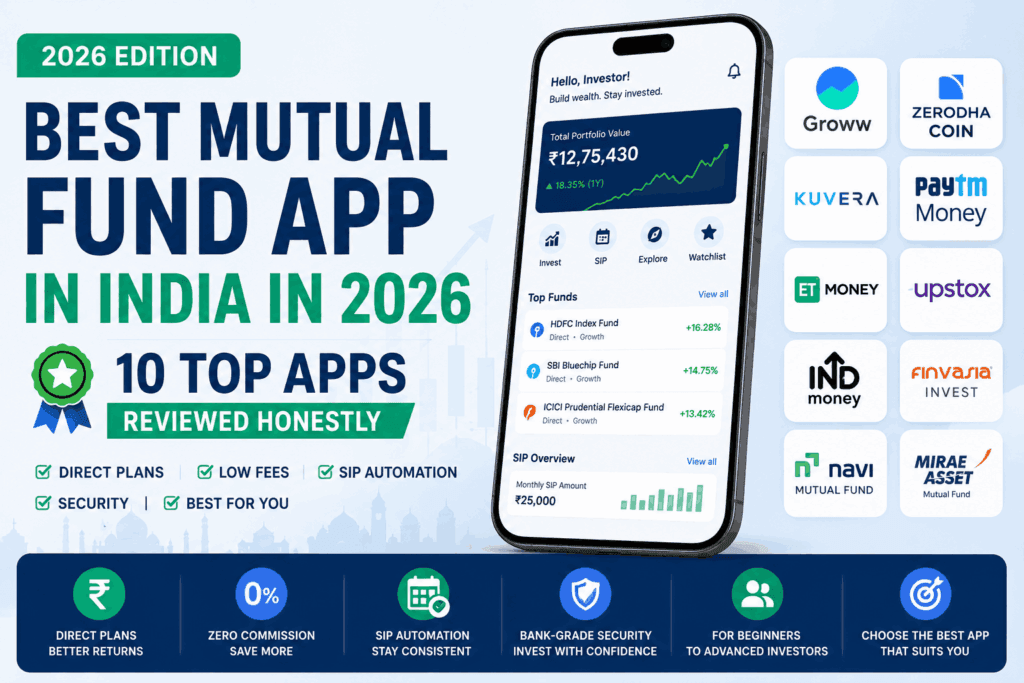
India’s mutual fund industry crossed Rs. 82 lakh crore in assets under management in early 2026, and monthly SIP contributions are now running above Rs. 29,000 crore. The volume of money flowing through mutual fund apps every single month has never been larger. Behind those numbers sit over 23 crore folios – and almost all of them today are opened, monitored and topped up through a phone.
Which app you choose to do that on matters more than most investors realise. The mutual funds themselves are the same regardless of which app you buy them through – HDFC Flexi Cap is HDFC Flexi Cap whether you buy it via Groww or directly from the AMC. But the way an app guides your choices, presents your portfolio, handles automation and charges (or doesn’t charge) you, ends up shaping your investing behaviour over years.
This is an independent guide to the best mutual fund app in India in 2026. We have evaluated 10 apps on direct-plan availability, SIP automation, goal planning, tax reporting, security and ecosystem fit – not on marketing or first-impression aesthetics. There is no single best app; there is the right app for what you are trying to do.
All 10 apps in this guide are SEBI-registered or partner with SEBI-registered AMCs and depositories. Your mutual fund units are held in your name with the AMC’s Registrar and Transfer Agent – the app cannot lose them even if the app shuts down tomorrow.
Why your choice of mutual fund app matters more than you think
If you think of a mutual fund app as just a glorified payment channel, you are missing the point. Three quiet decisions are baked into every app, and they compound over decades:
1. Direct plans vs regular plans
Direct plans of a mutual fund have an expense ratio that is roughly 0.5% to 1.5% lower than the regular plan of the same fund. That difference does not sound like much in any single year. Over 25 years of a Rs. 5,000 monthly SIP, it can cost you Rs. 12 lakh in lost compounding. Apps like Groww, Zerodha Coin, Kuvera and Paytm Money offer only direct plans. Apps that sell regular plans earn a commission embedded in your fund’s expense ratio.
2. Behavioural design
A well-designed app makes it easy to start a SIP, hard to redeem on impulse, and effortless to revisit your goal progress. A poorly-designed app does the opposite. The ‘panic redemption’ rate during the March 2020 crash was meaningfully lower on apps that buried the redemption button behind a confirmation flow.
3. Tax-reporting and portfolio consolidation
At year-end, your app’s capital-gains report can save you hours – or send you to a CA in panic. The better apps generate ITR-ready statements with breakdowns of long-term vs short-term gains, FIFO matching for SIPs, and grandfathering adjustments. Some apps still do not.
Best mutual fund apps in India 2026 – the shortlist
Here are the 10 apps we evaluated in this guide. All ten support direct plans, and all ten are SEBI-compliant. The differences sit in user experience, goal-planning depth, ecosystem fit and reporting quality.
| Rank | App | Best For | Min. SIP | Pricing Model |
|---|---|---|---|---|
| 1 | Groww | First-time investors | Rs. 100 | Direct plans, zero commission |
| 2 | Zerodha Coin | Existing Zerodha users | Rs. 100 | Direct plans, zero commission |
| 3 | Kuvera | Goal-based investors | Rs. 100 | Direct plans, zero commission |
| 4 | Paytm Money | Paytm ecosystem users | Rs. 100 | Direct plans, zero commission |
| 5 | ET Money | Data-driven investors | Rs. 500 | Direct plans, zero commission |
| 6 | INDmoney | Multi-asset trackers | Rs. 100 | Direct plans, zero commission |
| 7 | Angel One | Investors who want advice | Rs. 100 | Direct + Regular plans |
| 8 | Dhan | Active traders who SIP | Rs. 100 | Direct plans, zero commission |
| 9 | FundsIndia | Premium advisory experience | Rs. 500 | Direct + Regular + advisory |
| 10 | MyCAMS / KFinKart | Existing folio holders | Rs. 100 | AMC-direct, no app fee |
Detailed reviews – 10 best mutual fund apps for 2026
1. Groww – the default choice for first-time investors
Groww grew into India’s largest investing app on the back of one thing: making mutual funds simple enough that someone with no prior investing experience could start a SIP in their second visit to the app. It has held that lead through 2026, and for good reason.
The app sells only direct plans. Fund pages are clean, the historical returns are presented honestly with risk markers, and the SIP flow is genuinely three taps long. Onboarding through Aadhaar e-KYC takes under five minutes. Tax reporting at year-end is solid – not at Zerodha Coin’s level, but well above the industry average.
Minimum SIP: Rs. 100 on most schemes.
Direct plans: Yes, all mutual funds are direct.
Account fee: Free, no AMC.
Best for: Beginners and people who want one app for stocks, mutual funds and IPOs.
Pros
- Cleanest beginner UX in Indian investing – no jargon, no friction
- Truly zero-commission direct plans across the entire mutual fund universe
- Strong UPI Autopay integration for hands-off SIPs
- Large active user base means most issues are documented and solvable
- Stocks, mutual funds, IPOs and US stocks in one app
Cons
- Research and analytics are basic compared with Kuvera or ET Money
- Goal-based planning tools are functional but shallow
- Customer support during peak hours can be slow
- No advisor-led planning – you make every decision on your own
2. Zerodha Coin – cleanest experience for serious DIY investors
Coin is Zerodha’s mutual fund platform, and it is the rare app that has stayed deliberately simple for over a decade. There is no marketing noise, no ‘star ratings,’ no ‘top picks of the month.’ You search for a fund, you see its disclosed performance, you invest. That austerity is the entire point – and it is exactly what experienced investors come for.
Coin is the most tightly-integrated mutual fund app with the broader Zerodha ecosystem. Capital gains reports – generated from your Zerodha Console – are arguably the best in the industry. If you already use Kite for stocks, Coin is the natural mutual fund choice.
Minimum SIP: Rs. 100 on most schemes.
Direct plans: Yes, only direct plans.
Account fee: Requires an active Zerodha demat account (Rs. 200 opening, Rs. 300 AMC).
Best for: DIY investors who already trade on Zerodha or want the cleanest reporting.
Pros
- Most reliable tax-reporting and capital-gains statement generation
- Holdings shown in your demat account (not folio-based) – cleaner consolidation
- Integrated with Zerodha Console for portfolio analytics
- No upsell, no clutter, no recommendation engine – the experienced investor’s app
Cons
- Requires a Zerodha demat account – not useful as a standalone MF app
- Lives in a separate app from Kite (the trading app), which annoys some users
- No goal-planning tools or family account features
- Demat AMC of Rs. 300/year may not be worth it if you only do mutual funds
3. Kuvera – best for goal-based and family investing
Kuvera occupies the sweetspot between Groww’s simplicity and a full-fledged wealth manager. It is SEBI-registered as an Investment Adviser, sells only direct plans, and is built around goal-based investing. You set a target – house downpayment in 7 years, child’s college in 15, retirement in 30 – and Kuvera builds, monitors and rebalances a portfolio against it.
Two features set Kuvera apart from the pack. The first is family accounts – you can link your spouse’s and children’s portfolios in one view, with consolidated capital-gains reporting. The second is tax harvesting – the app actively flags opportunities to realise long-term gains within the Rs. 1.25 lakh annual exemption.
Minimum SIP: Rs. 100 on most schemes.
Direct plans: Yes, all direct.
Account fee: Free.
Best for: Goal-based investors, families, anyone serious about long-term planning.
Pros
- Best-in-class goal-based investing framework
- Family account feature is genuinely useful for joint planning
- Active tax harvesting recommendations
- Clean portfolio rebalancing suggestions
- Also offers US stocks for global diversification
Cons
- Learning curve is steeper than Groww or Paytm Money
- Smaller user community means fewer YouTube tutorials and Reddit threads
- Some advanced features (Coachfin) sit behind a premium tier
- App stability can be inconsistent during heavy market days
4. Paytm Money – friction-free for the Paytm ecosystem
Paytm Money sits in an interesting spot. The app itself is competent – direct plans, zero commission, SIPs from Rs. 100, simple onboarding via UPI Autopay – and for someone who already lives inside the broader Paytm ecosystem for payments, switching to it for mutual funds is almost frictionless. The catch is the parent company’s regulatory journey through 2024-2025, which has caused some product offerings to narrow.
For pure mutual fund use, the platform continues to operate normally and remains a sensible choice. If you also wanted Paytm Money for stock trading or international investing, look more carefully at current product availability before committing.
Minimum SIP: Rs. 100.
Direct plans: Yes, all direct.
Account fee: Free, no AMC.
Best for: Existing Paytm users who want one-tap MF investing.
Pros
- Tight integration with Paytm’s payments stack – UPI Autopay is seamless
- Clean, beginner-friendly mutual fund interface
- Direct plans with zero commission
- ELSS section is well-organised for tax-saving SIP planning
Cons
- Regulatory cloud over the parent has dented trust for some users
- Research depth is limited
- Goal-planning tools are basic
- Smaller mutual fund ecosystem coverage than Groww
5. ET Money – data-driven fund selection
ET Money, owned by the Times Internet group, has built its identity around analytics. The app surfaces ‘SmartDeposit’ for short-term parking, ‘Investment Pack’ bundles for goal-driven investing, and proprietary fund ratings backed by quantitative research. If you find decision-making easier with more data, this is your app.
ET Money also goes beyond mutual funds – it offers NPS, insurance, and tax-filing services – which makes it useful as a broader personal finance hub. The mutual fund SIP minimum is Rs. 500, higher than Groww’s Rs. 100, but it remains accessible for most investors.
Minimum SIP: Rs. 500.
Direct plans: Yes, all direct.
Account fee: Free.
Best for: Investors who like data and want a broader personal finance app.
Pros
- Strong fund analytics and proprietary rating system
- ‘SmartDeposit’ is genuinely useful for short-term parking of idle cash
- Goes beyond mutual funds – NPS, insurance, tax filing in one app
- Solid SIP automation and goal tracking
Cons
- Rs. 500 minimum SIP is higher than competitors
- Cross-sell into insurance and lending products can be aggressive
- Some ‘recommendation’ features feel marketing-led rather than research-led
- Slightly cluttered interface compared with Groww
6. INDmoney – multi-asset consolidation across markets
INDmoney has carved out a niche as the most comprehensive multi-asset tracking app in India. It supports Indian mutual funds, Indian stocks, US stocks (with direct access via the Liberalised Remittance Scheme), EPF tracking, credit-score monitoring, and even loan management in a single dashboard. If you hold investments across multiple categories and want one app to see everything, this is hard to beat.
The mutual fund offering itself is solid – direct plans only, zero commission, automated SIPs – but the real differentiator is consolidation. You can import your existing folios from any AMC and have everything in one view, which most apps cannot match without manual entry.
Minimum SIP: Rs. 100.
Direct plans: Yes, all direct.
Account fee: Free; US investing has its own fee structure.
Best for: Investors with assets across multiple categories who want a unified view.
Pros
- Best multi-asset consolidation in Indian fintech
- Direct access to US stocks – useful for global diversification
- EPF and credit score tracking on the same dashboard
- Strong portfolio analytics and net-worth tracking
Cons
- App can feel overwhelming with everything turned on
- Some premium features sit behind a paywall
- US investing involves currency conversion costs to factor in
- Loan and credit offerings can feel like cross-sells
7. Angel One – mutual funds plus research and stocks in one app
Angel One is primarily a stockbroker but its mutual fund offering is robust enough to recommend on its own merits. The differentiator is that Angel One offers both direct and regular plans, plus its in-house ARQ Prime AI recommendations and research reports – so investors who want some hand-holding can get it without going to a separate advisory firm.
For an investor who plans to dabble in stocks alongside mutual funds, Angel One’s all-in-one app is more convenient than running Coin alongside Kite. The trade-off is depth – Coin’s tax reporting and Kuvera’s goal planning are both better.
Minimum SIP: Rs. 100.
Direct plans: Yes (also regular plans available).
Account fee: Free first year, then nominal AMC.
Best for: Investors who want stocks + mutual funds + research in one app.
Pros
- Stocks, mutual funds, F&O and advisory in a single platform
- ARQ Prime AI recommendations bundled in
- Strong research reports for fundamental investors
- Wide product mix including commodities and currencies
Cons
- Sells both direct and regular plans – make sure you select ‘Direct’
- App can feel busy with stocks and MFs side by side
- Mutual fund-specific features lag dedicated MF apps
- Occasional cross-sell prompts into adjacent products
8. Dhan – mutual funds inside a serious trader’s app
Dhan is best known as a trading app for active F&O and options traders, but its mutual fund offering is a quiet strength. You get 1,700+ direct mutual fund schemes with zero commission, daily/weekly/monthly SIP options, and full Autopay integration – all inside the same app you might use for stocks. For someone who plans to graduate from passive SIP investing to active trading over time, Dhan removes the friction of switching apps.
The trade-off is that Dhan’s app is designed for traders first. The mutual fund section is competent but does not feel like the primary product. If you only do mutual funds, Groww or Kuvera will serve you better.
Minimum SIP: Rs. 100.
Direct plans: Yes, all direct.
Account fee: Free, no AMC.
Best for: Active traders who also want to SIP into mutual funds from the same app.
Pros
- Wide selection of direct mutual fund schemes
- Strong SIP automation and Autopay setup
- Bundle with serious trading tools (TradingView charts) if you also trade
- Zero AMC and free account opening
Cons
- Mutual fund UI feels secondary to the trading app’s primary focus
- No goal-planning or family-account features
- Less educational content for pure mutual fund investors
- Beginner UX is steeper than dedicated MF apps
9. FundsIndia – premium advisory experience
FundsIndia has been around since 2009 and pre-dates the discount-broker wave. It positions itself as a premium investment advisory platform – which means a real human advisor relationship if you want one, alongside the standard self-directed mutual fund flow. The platform offers both direct plans for DIY investors and regular plans (with embedded commissions) for those who use the advisory service.
If you genuinely want hand-holding from a registered investment advisor and are willing to pay a slightly higher expense ratio for it, FundsIndia delivers. If you are a confident DIY investor, the same money is better spent on direct plans through a free app like Groww or Kuvera.
Minimum SIP: Rs. 500.
Plans: Both direct and regular.
Account fee: Free for direct; regular plans have embedded commissions.
Best for: Investors who want a human advisor relationship in their app.
Pros
- Real advisory relationship if you want it
- Long operating history (since 2009) – mature platform
- Good research reports and curated portfolios
- Family-account support
Cons
- Regular plans cost more than direct plans over the long run
- App UX is dated compared with newer rivals
- Higher minimum SIP than most competitors
- Advisor relationship adds value mainly for HNI ticket sizes
10. MyCAMS / KFinKart – direct from the Registrar and Transfer Agents
CAMS and KFintech are India’s two Registrar and Transfer Agents (RTAs) – the back-office layer that handles mutual fund unit issuance for all AMCs. Their consumer apps, MyCAMS and KFinKart, let you invest in any direct mutual fund whose AMC is serviced by them – which is most major AMCs. The flow is barebones compared with Groww, but completely free, without any intermediary.
These apps come into their own when you already hold folios across multiple AMCs and want to invest into existing folios rather than creating duplicates via a third-party app. They are also useful for older investors who started before the app era and want to consolidate digitally without disturbing their folio structure.
Minimum SIP: Per-scheme minimum (often Rs. 100).
Direct plans: Yes, only direct.
Account fee: Free – no intermediary.
Best for: Existing folio holders who want AMC-direct investment without any third-party app.
Pros
- Investing directly with the RTA – no intermediary layer
- Useful for existing folio holders who want to top up old folios
- Free, no commission, no AMC, no premium tier
- Strong consolidated statement generation
Cons
- Bare-bones UX – functional but not beautiful
- Two separate apps because CAMS and KFintech serve different AMCs
- No goal planning, no consolidated cross-RTA portfolio view
- No research or recommendations – you bring your own thesis
Feature comparison – what each app actually supports
Feature parity has improved across the industry, but meaningful differences still exist – particularly in goal planning, tax reporting and international assets.
| App | Direct Plans | SIP Autopay | Goal Planning | Tax Reports | US Stocks |
|---|---|---|---|---|---|
| Groww | Yes | UPI Autopay | Basic | Yes | Yes |
| Zerodha Coin | Yes | Yes | No | Yes (excellent) | No |
| Kuvera | Yes | Yes | Yes (best-in-class) | Yes | Yes |
| Paytm Money | Yes | UPI Autopay | Basic | Yes | Historical |
| ET Money | Yes | Yes | Yes | Yes | No |
| INDmoney | Yes | Yes | Yes | Yes | Yes (deep) |
| Angel One | Both | Yes | Limited | Yes | No |
| Dhan | Yes | Yes | No | Yes | No |
| FundsIndia | Both | Yes | Advisor-led | Yes | No |
| MyCAMS / KFinKart | Yes | Yes | No | Limited | No |
Direct vs regular mutual funds – the choice that compounds the most
Before picking an app, get one decision right: are you buying direct plans or regular plans? It is the single highest-impact choice you will make in your entire mutual fund journey.
| Aspect | Direct Plan | Regular Plan |
|---|---|---|
| Distributor commission | None – you deal with the AMC directly | Includes commission to the distributor/advisor |
| Annual expense ratio | Lower by approximately 0.5% – 1.5% | Higher because of the trail commission embedded |
| NAV | Higher NAV for the same scheme | Lower NAV due to higher expense ratio |
| Long-term wealth impact | Significantly higher over 10+ years | Lower terminal value due to compounding drag |
| Where to buy | AMC websites, MFU, MyCAMS, KFinKart, Groww, Zerodha Coin, Kuvera, Paytm Money, ET Money, INDmoney, Dhan | Banks, brokers offering regular plans, distributors |
| Suited for | DIY investors comfortable with selecting funds | Investors who want hand-holding from an advisor |
The compounding cost of regular plans over time
Here is what the difference actually looks like for an investor putting in Rs. 5,000 a month, assuming the equity fund returns the same 12% gross in both cases, with a 1% gap between direct and regular expense ratios. We are not making the funds different – just changing the plan you bought.
| Time Period | Invested | Direct (~0.7% ER) | Regular (~1.7% ER) | Cost of choosing Regular |
|---|---|---|---|---|
| 10 years (Rs. 5,000/mo SIP) | Rs. 6 lakh | Rs. 11.6 lakh | Rs. 11.0 lakh | Rs. 60,000+ |
| 15 years (Rs. 5,000/mo SIP) | Rs. 9 lakh | Rs. 25.2 lakh | Rs. 23.4 lakh | Rs. 1.8 lakh+ |
| 20 years (Rs. 5,000/mo SIP) | Rs. 12 lakh | Rs. 50 lakh | Rs. 44.9 lakh | Rs. 5 lakh+ |
| 25 years (Rs. 5,000/mo SIP) | Rs. 15 lakh | Rs. 94.9 lakh | Rs. 82 lakh | Rs. 12.9 lakh+ |
| 30 years (Rs. 5,000/mo SIP) | Rs. 18 lakh | Rs. 1.76 crore | Rs. 1.45 crore | Rs. 31 lakh+ |
The Rs. 31 lakh gap at 30 years is not because the fund underperformed. It is because someone took a small commission off the top, every year, and let compounding do the destructive work.
Security, regulation and what “safe” actually means
All 10 apps on this list operate under SEBI regulation, either directly as registered intermediaries or by partnering with SEBI-regulated AMCs and RTAs. Three layers of protection apply regardless of which app you choose:
- Units held with the AMC, not the app. Your mutual fund units are recorded in the AMC’s books via the Registrar and Transfer Agent. If your app shuts down tomorrow, your units stay with the AMC under your name and PAN, and you can transition to MFU, MyCAMS, KFinKart, or another platform without losing anything.
- Money flows directly to the AMC. When you initiate a SIP, the bank debit goes directly to the AMC’s pool account, not via the app’s account. The app is just the order-placement interface.
- Investor Education and Protection Fund. Even if an AMC were to face liquidity issues (extremely rare in India), SEBI’s investor protection framework applies. For mutual funds, the bigger risk is fund underperformance, not the platform failing.
Beyond the legal framework, basic security hygiene matters:
- Two-factor authentication at login – mandatory under SEBI’s recent KYC framework
- Biometric login (fingerprint or face ID) on the app
- Encrypted data transmission (TLS 1.2 or higher)
- Verify the app is downloaded from official stores – phishing fake apps remain a real threat
- Never share your PAN, password or OTP with anyone, including app support staff
How to choose the right mutual fund app for you in 2026
Five filters, applied in order, will get you to the right choice faster than reading another review article:
1. Are you a complete beginner?
Pick Groww or Paytm Money. The UX assumes nothing, the minimum SIPs start at Rs. 100, and you cannot break anything. Save the advanced apps for when you have a year of experience under your belt.
2. Are you already using Zerodha for stocks?
Use Coin. Tax reports are best-in-class, demat consolidation is clean, and you do not pay any additional fees. The only reason not to is if you specifically need goal-planning features Coin does not have.
3. Do you have specific long-term goals to plan against?
Kuvera. Family accounts, goal tracking, tax harvesting and rebalancing are genuinely better here than anywhere else. The premium tier (Coachfin) adds advisor consultations if you want them.
4. Do you hold investments across multiple categories?
INDmoney. Indian stocks, US stocks, mutual funds, EPF, credit score, loans – one dashboard. The consolidation alone justifies the choice if you have a complex financial picture.
5. Do you want one app for both stocks and mutual funds?
Groww if you are a casual investor, Angel One if you want research bundled in, Dhan if you also plan to do F&O over time.
What changed in the Indian mutual fund landscape in 2026
LTCG tax rate at 12.5% above Rs. 1.25 lakh
Equity mutual fund long-term capital gains – units held for more than 12 months – are taxed at 12.5% on gains above Rs. 1.25 lakh per financial year. The exemption was raised from Rs. 1 lakh by Budget 2024 and continues in 2026. The exemption is cumulative across all your equity holdings; it does not carry forward.
STCG raised to 20%
Equity short-term capital gains – units held for less than 12 months – are now taxed at 20%, up from 15%. The cost of redeeming SIP units early has gone up. Hold equity SIP units for at least 12 months from each instalment to qualify for LTCG.
Debt funds bought after April 2023 lose LTCG benefit
Debt mutual fund units acquired on or after April 1, 2023 are now treated as short-term regardless of holding period and taxed at your slab rate. Indexation benefit has been removed. The bottom line: pure debt funds are no longer tax-efficient for long-term parking. Hybrid funds with 35%+ equity still get LTCG benefits.
Section 80C deduction works only under old tax regime
ELSS funds remain the only mutual fund category that gives a tax deduction at the time of investment (up to Rs. 1.5 lakh under Section 80C). But this deduction is available only under the old tax regime. If you are filing under the new regime (default since 2024), ELSS gives no upfront tax break – it just becomes another equity fund.
UPI Autopay is now the SIP standard
Most major apps have moved their default SIP setup to UPI Autopay rather than the older NACH mandate. UPI Autopay activates instantly, can be cancelled anytime through your UPI app, and has near-zero failure rates. If your app still defaults to NACH-based SIPs, it is using yesterday’s plumbing.
Mistakes that cost mutual fund app users the most money
1. Buying regular plans by mistake
On apps that sell both direct and regular plans (Angel One, FundsIndia, banks’ apps), check carefully that you are selecting ‘Direct – Growth’. Some apps default to regular plans because they earn commission. Over 20 years, this single mistake can cost lakhs.
2. Using too many apps
Holding the same fund across three different apps fragments your folio structure, complicates tax reporting at year-end, and adds zero diversification. Pick one or two apps and consolidate.
3. Stopping SIPs during corrections
Mathematically the worst time to stop a SIP – the same money buys more units when NAVs are down. The apps that have built friction into the redemption flow (Coin, Kuvera) do their users a quiet behavioural favour.
4. Treating fund star ratings as buy signals
Star ratings are backward-looking. A fund’s 5-star rating reflects how it did over a particular window in the past; that is not the same as how it will do in your investment horizon. Treat ratings as one input, not the decision.
5. Ignoring the consolidated account statement (CAS)
Every six months, CDSL/NSDL send a Consolidated Account Statement to your email with all your mutual fund holdings across AMCs and apps. Most investors don’t open it. This is the most accurate single document of your investments and worth a 10-minute review.
6. Letting idle bank balances sit
If you have Rs. 50,000+ sitting in a savings account earning 3-4%, an app like ET Money’s SmartDeposit (or any liquid mutual fund via Groww/Coin) can earn 6.5-7%. The setup takes five minutes. The return uplift is real.
Frequently Asked Questions
Q1. Which is the best mutual fund app in India in 2026?
There is no single best app – the right choice depends on what you need. Groww is the best for first-time investors and simplicity, Zerodha Coin is the best for DIY investors who already use Zerodha for stocks, Kuvera is the best for goal-based and family investing, Paytm Money is the best for the Paytm ecosystem, and ET Money is the best for data-driven fund selection. All five are SEBI-compliant and sell direct plans only.
Q2. Are mutual fund apps in India safe?
Yes, when chosen properly. All major apps in this guide are SEBI-registered or partner with SEBI-regulated AMCs and Registrar and Transfer Agents. Your mutual fund units are held by the AMC under your PAN and folio, not by the app. Even if the app shuts down, your units remain with the AMC and can be accessed via MFU, MyCAMS, KFinKart or another platform. Always download apps from official stores and enable two-factor authentication.
Q3. Which mutual fund app has the lowest cost?
All apps that sell only direct plans – Groww, Zerodha Coin, Kuvera, Paytm Money, ET Money, INDmoney, Dhan, MyCAMS, KFinKart – have effectively zero cost. They earn money through other product lines (stocks, US investing, advisory premium tiers) rather than commissions on mutual funds. The ‘lowest cost’ question really comes down to whether you choose direct plans over regular plans – that 1% difference in expense ratio compounds dramatically over decades.
Q4. What is the difference between direct and regular plans?
Direct plans cut out the distributor and are bought straight from the AMC; the expense ratio is roughly 0.5-1.5% lower than the regular plan of the same fund. Regular plans include a trail commission paid to the distributor or advisor who sold the fund, which raises the expense ratio. The underlying fund is identical – the difference is purely in the cost structure. For DIY investors, direct plans are almost always better.
Q5. Can I start a SIP with just Rs. 100?
Yes, on most major apps. Groww, Zerodha Coin, Kuvera, Paytm Money, INDmoney, Dhan and Angel One all support SIPs from Rs. 100 per month on at least some schemes. ET Money and FundsIndia have slightly higher minimums of Rs. 500. The actual minimum depends on the fund itself – some schemes have a Rs. 1,000 floor regardless of the app.
Q6. How are mutual fund returns taxed in 2026?
Equity mutual funds: long-term capital gains (held more than 12 months) are taxed at 12.5% on gains above Rs. 1.25 lakh per financial year. Short-term gains are taxed at 20%. Debt mutual funds purchased on or after April 1, 2023: all gains are treated as short-term and taxed at your slab rate, regardless of holding period. ELSS funds retain Section 80C deduction up to Rs. 1.5 lakh – but only under the old tax regime.
Q7. Can I have multiple mutual fund apps on the same PAN?
Yes. Your PAN identifies you uniquely with SEBI and the AMCs, so you can hold folios across multiple apps. The Consolidated Account Statement (CAS) from CDSL/NSDL pulls everything together every six months. That said, consolidating to one or two apps makes tax reporting and portfolio tracking much easier – so use the multi-app option deliberately, not by accident.
Q8. Do mutual fund apps offer US stocks?
Some do. Groww, Kuvera and INDmoney all offer US stock investing through partner platforms. INDmoney has the deepest US stock offering. Note that international investing falls under the RBI’s Liberalised Remittance Scheme (LRS), with a $250,000 per financial year limit per individual.
Q9. What happens if my mutual fund app shuts down?
Your mutual fund units are held by the AMC under your PAN and folio – the app is just an order-placement interface. If the app shuts down, you can access your units via MFU (Mutual Fund Utility), MyCAMS, KFinKart, the AMC’s own website, or a different app. You may need to re-link your folio in a new app, but the units themselves are not at risk.
Q10. Which mutual fund app should a complete beginner pick?
Groww. The onboarding flow takes under five minutes, the minimum SIP is Rs. 100, the app only sells direct plans (so you do not accidentally buy a regular plan with hidden commissions), and the educational content is calibrated for someone who has never bought a mutual fund before. As your needs evolve – say, you want goal planning or family accounts – you can switch to Kuvera. But Groww is the right starting point.
Final verdict
The best mutual fund app in India in 2026 is not a question with a single answer – it is a question that resolves once you are clear about what you want to do.
For most first-time investors, Groww is the right starting point. The friction is genuinely lowest, the direct plans save you the compounding tax of regular plans, and the app does not pretend you understand things you don’t. For DIY investors who already trade stocks on Zerodha, Coin is the cleanest fit because of tax reporting and demat integration. For goal-based and family investors, Kuvera is in a category of its own. And for anyone with assets spanning Indian and global markets, INDmoney handles the consolidation problem better than anyone.
Three things compound over decades of mutual fund investing – and all three are decisions you make at the app level, not at the fund level:
- Direct over regular plans. The single most expensive mistake you can make is buying regular plans without realising. Pick an app that sells only direct plans, or be vigilant when you select the plan type.
- Automation over willpower. Set up UPI Autopay SIPs and forget them. The money compounds when you stop thinking about it, not when you actively manage it.
- One or two apps, not five. Fragmenting across multiple apps wastes time at tax season and confuses your own portfolio review. Pick one for SIPs, maybe a second for consolidation, and stop there.
Start with the simplest fit for your situation. The first month of actually using a mutual fund app will tell you more about whether it suits you than any review can. This one included.
The best mutual fund app is the one whose SIPs you will still be running ten years from now, untouched. Optimise for that, not for whichever app is trending this quarter.
